

Performance marketing isn’t just about spending money on ads and hoping for the best. You need to think like a performance marketer if you want to turn your digital campaigns into profit-generating machines that scale.
Who this guide is for: Marketing managers, business owners, and digital marketers who want to move beyond basic ad campaigns and build data-driven systems that deliver measurable results and sustainable growth.
Most marketers get stuck running individual campaigns without understanding the bigger picture. Real performance marketing requires a complete mindset shift toward optimization, testing, and systematic thinking. You’ll learn how to optimize your customer funnel for maximum conversions, run continuous testing to improve campaign performance, and strategically scale paid media campaigns.
We’ll also cover how to maximize customer lifetime value beyond the first purchase and how to build marketing automation systems that actually scale your business rather than just creating more work.
Master the Performance Marketing Mindset

Focus on ROI-Driven Metrics Instead of Vanity Numbers
You need to shift your focus from vanity metrics to ROI-driven measurements that directly impact your bottom line. While traditional marketing often emphasizes exposure and impressions, performance marketing requires you to track metrics that justify the cost and effort of your campaigns. Your ROI is a crucial marketing KPI that reflects the profitability and effectiveness of your marketing efforts.
Treat Every Marketing Dollar as a Measurable Investment
Revenue marketing can be expensive, so you must ensure you’re getting an optimal return on your investment. You should evaluate every marketing dollar spent through the lens of measurable outcomes rather than speculative techniques. This approach transforms marketing from an art into a science, where every move, campaign, and strategy makes a measurable impact on your business growth and profitability.
Optimize Your Customer Funnel for Maximum Conversions
Optimize Your Customer Funnel for Maximum Conversions
Map the Complete Customer Journey from Awareness to Advocacy
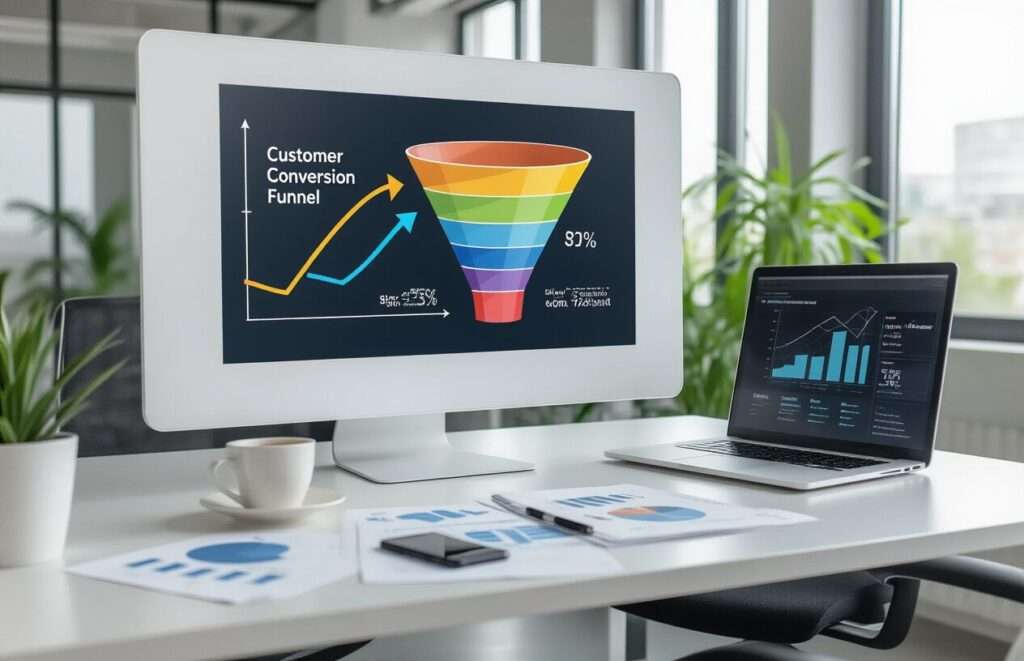
Your conversion funnel serves as a strategic roadmap that visualizes your prospects’ complete buying journey, from initial awareness through advocacy. Understanding the distinction between your customer journey and conversion funnel is crucial. While the customer journey provides an epic panoramic view of the entire experience, your conversion funnel focuses specifically on the critical path to conversion. This tightly plotted narrative guides potential customers through five essential stages: awareness, interest, desire, action, and re-engagement, ultimately creating brand evangelists who impact future funnel filling.
Identify and Fix Conversion Leaks at Every Stage
Now that you’ve mapped your customer journey, you need to systematically identify where prospects drop off at each stage of the funnel. Your conversion funnel analysis should focus on key metrics, including cost per acquisition, customer lifetime value, conversion rates, click-through rates, engagement rates, and average order value. By tracking these metrics across your top-of-funnel awareness, middle-of-funnel interest, and bottom-of-funnel decision stages, you can pinpoint specific leak points and implement targeted optimization strategies to reduce friction and improve conversion rates.
Use Behavior Analytics to Understand User Drop-Off Points
With conversion leaks identified, you must leverage behavior analytics tools to understand why users abandon your funnel at specific points. Tools like Hotjar, Microsoft Clarity, Google Analytics 4, Mixpanel, Amplitude, and Fullstory provide crucial insights into user behavior patterns and drop-off points. These analytics platforms help you track engagement levels, browsing behaviors, and purchasing history, enabling you to create behavioral segments that reveal exactly where and why prospects disengage from your conversion process.
Align Content and Messaging to Funnel Stages
Previously, you’ve identified your drop-off points through behavior analytics. Now you need to strategically align your content and messaging to each specific funnel stage. At the top of the funnel, focus on awareness-stage content, including blog posts, articles, ads, and social posts. For middle-of-funnel prospects, deploy interest-capturing content like product reviews, comparisons, and personalized email campaigns. Bottom-of-funnel leads require decision-focused tactics,s including reminder emails, promotional offers, retargeting ads, and optimized product pages that drive final conversion actions.
Run Continuous Testing to Improve Campaign Performance

A/B Test Headlines, Creative Assets, and Call-to-Actions
Your testing strategy should follow the same principles as the continuous testing approach in software development. Start by automating your A/B tests for headlines, creative assets, and call-to-actions to get rapid feedback on what drives conversions. Focus on testing early and often throughout your campaign lifecycle, prioritizing tests that deliver the most business value aligned with your conversion goals.
Experiment with Audience Targeting and Segmentation
Use a scientific approach to audience testing by implementing automated testing frameworks that can run concurrent experiments across different segments. Just as continuous testing in software development catches issues early, your audience experiments should provide fast feedback to identify high-performing segments before you scale your budget.
Scale Paid Media Campaigns Strategically

Segment Campaigns by Funnel Stage and Customer Intent
When scaling your paid media campaigns, you need to organize your approach based on where prospects are in their buyer’s journey. Your prospecting campaigns should target cold audiences with broader messaging, while retargeting campaigns focus on people who’ve already interacted with your brand. This segmentation allows you to allocate budgets more effectively and create messaging that resonates with each stage.
Track conversion metrics for each funnel stage to identify which segments deliver the best return on ad spend. Use this data to prioritize high-performing audience segments and gradually increase investment in campaigns that consistently drive quality leads.
Leverage Lookalike Audiences Based on High-Value Customers
Creating lookalike audiences from your best-performing customers is one of the most effective ways to expand reach while maintaining relevance. Use first-party data from your highest-value customers, longest-tenure clients, or most engaged prospects to build these audiences. Platforms can then identify similar users who are more likely to convert.
Start with smaller lookalike percentages for tighter targeting, then gradually expand to larger audiences as you scale. This approach helps you find new pockets of prospects while maintaining campaign efficiency and reducing wasted ad spend.
Implement Dynamic Creative Optimization
Dynamic creative optimization automatically tests different combinations of headlines, images, and calls to action to identify the best-performing variations. This approach eliminates guesswork and ensures your creatives stay fresh as you scale. Different creative themes will resonate with different audience segments, so testing various approaches helps you connect with broader audiences.
Monitor creative performance closely and refresh underperforming assets to prevent ad fatigue. A/B test key variables like ad copy, visuals, and messaging to find winning combinations before increasing spend on proven creative assets.
Use AI-Powered Targeting to Reduce Ad Waste
AI-driven targeting tools can automatically shift budgets to high-performing campaigns while reducing spend on underperforming ones. These platforms analyze large datasets to optimize audience targeting and bidding strategies in real time, making scaling more efficient without increasing manual workload.
Set up automated budget rules based on performance thresholds to prevent wasted spend and maintain campaign efficiency. AI tools help you make data-driven decisions by identifying patterns in audience behavior and adjusting targeting parameters to focus on prospects most likely to convert.
Maximize Customer Lifetime Value Beyond First Purchase

Calculate True Customer Profitability Over Time
Now that we’ve established the foundation of performance marketing thinking, you need to move beyond tracking surface-level metrics like conversion rates. True customer profitability emerges when you analyze the complete picture: average revenue per period, gross margin, and customer lifespan working together as multipliers. A customer who pays $100 monthly and stays 12 months generates $1,200 LTV, but extending their retention to 24 months doubles that value to $2,400 without changing acquisition costs.
Build Automated Retention and Upsell Campaigns
With your profitability calculations in place, you can now create trigger-based campaigns that systematically maximize customer value. Use behavioral signals like declining login frequency, reduced feature usage, or support ticket patterns to identify at-risk customers weeks before they churn. Build health scores combining these signals, then trigger personalized interventions—whether that’s account manager outreach, feature walkthroughs, or proactive support calls—before customers mentally check out.
Create Cross-Device Retargeting Sequences
Previously, we’ve seen how behavioral data drives retention campaigns, but your retargeting must span every touchpoint where customers interact with your brand. Design sequences that follow customers across devices and platforms, triggering relevant messages based on their engagement patterns. When a customer repeatedly visits your reporting dashboard, detect this pattern and proactively offer relevant tutorials or feature upgrades at the perfect moment, creating that seamless experience that transforms casual users into loyal advocates.
Develop Personalized Customer Experiences
With cross-device tracking established, you can now craft truly personalized experiences that reward behaviors correlating with long-term retention. Move beyond transaction-based rewards to recognize actions like engaging with educational content, referring other customers, adopting multiple product features, or participating in community forums. These behaviors signal deep engagement, and rewarding them reinforces the actions that naturally extend customer lifespan while building stronger relationships that compound into higher lifetime value over time.
Build Marketing Automation Systems That Scale

Set Up Automated Email Flows for Customer Nurturing
Your email automation becomes the backbone of customer nurturing when you implement AI-driven workflows that respond to specific behaviors and segment audiences for maximum relevance. Automated triggers optimize send times, improve engagement rates, and reduce manual campaign management overhead. Advanced nurturing streams guide prospects through the buying cycle with automated sequences that keep leads engaged, streamline follow-ups, and shorten sales cycles by mapping communications directly to buyer needs.
Implement Smart Budget and Bid Management Rules
Your ad operations automation ensures digital campaigns run efficiently through automated bidding, creative testing, and spend allocation. These smart rules optimize campaigns in real time, leveraging actionable insights to provide ongoing improvement without constant manual intervention. When cohort reply rates spike, your automated system reallocates spend. It automatically shortens touch sequences, eliminating guesswork in budget distribution and ensuring your highest-performing segments receive increased firepower within 24 hours of performance changes.
Create CRM-Integrated Lead Scoring Systems
Your CRM integration becomes a growth engine when you sync events through automated lead tagging, scoring, and routing systems that reduce lead response time by up to 80 percent. Enriched profiles feed into automated multi-touch nurture sequences, generating personalized experiences in minutes rather than days. Automated triggers for lead scoring and SLA alerts ensure sales teams get notified when prospects cross conversion thresholds. At the same time, strong cohorts automatically receive more marketing firepower based on real-time performance data.
Automate Reporting and Performance Monitoring
Your performance monitoring becomes a continuous optimization system when you connect dashboards to automatically populate weekly reports that highlight deviations and wins without manual intervention. Automated systems track campaign performance and customer responses in real-time, providing a better understanding of what works through systematic A/B experiments that spin up automatically whenever you update key assets. This living loop increases campaign ROI by up to 25 percent while your attribution and automation operate on the same clock, eliminating delays in performance insights.
Collaborate Cross-Functionally for Better Results

Align Creative Teams for High-Converting Visual Assets
Now that you’ve established your performance marketing foundation, cross-functional collaboration with creative teams is essential to drive maximum conversions. You need to break down the traditional silos where creative teams work in isolation from performance data. When you align your creative specialists with performance marketing objectives, you create a feedback loop that continuously improves the effectiveness of visual assets.
Work with Data Teams for Accurate Attribution
With creative alignment in place, your next priority should be partnering with data teams to establish accurate attribution models. You can’t optimize what you can’t measure accurately. By fostering clear communication channels between marketing and data specialists, you ensure that attribution tracking captures the full customer journey across all touchpoints, enabling data-driven decisions to optimize campaigns.
Leverage Advanced Performance Marketing Channels

Implement Connected TV for Premium Brand Reach
Connected TV advertising places non-skippable, high-impact ads on smart TVs and streaming devices like Roku, Apple TV, and Amazon Fire TV Stick. By leveraging premium, full-screen placements, you can ensure your message reaches audiences in a distraction-free, living-room environment, with cost-per-thousand-impressions and cost-per-completed-view models.
Use Multi-Channel Attribution for Complete Customer Journey Tracking
Multi-channel attribution connects ad impressions to site visits and conversions across various touchpoints, providing clear visibility into campaign performance. This data-driven approach allows you to understand customer behavior throughout the buying journey, enabling precise tracking of marketing spend and direct correlation with measurable outcomes for maximum ROI.

Thinking like a performance marketer requires a fundamental shift from vanity metrics to measurable outcomes. By mastering the performance marketing mindset, optimizing your customer funnel, running continuous tests, and scaling strategically, you transform every marketing dollar into a calculated investment. Remember, it’s not about running ads—it’s about building systems that maximize customer lifetime value, leverage automation, and drive cross-functional collaboration to achieve scalable growth.
The path forward is clear: obsess over metrics that matter, treat your funnel as sacred, and let data guide every decision. Whether you’re optimizing conversion rates, exploring advanced marketing channels, or building automation systems, the performance marketing approach ensures you’re always moving toward profitable, measurable results. Start implementing these strategies today, and watch as your marketing efforts evolve from cost centers into powerful revenue engines that fuel your business growth.
