
Most interview question lists for digital marketing freshers give you textbook definitions. Interviewers have heard “SEO stands for Search Engine Optimization, which is the process of improving a website’s visibility” hundreds of times. It doesn’t tell them whether you can actually do the work.
What separates a memorable fresher from the rest is evidence. Not years of experience, which no fresher has, but proof that you’ve applied what you learned to something real: a website you optimized, a campaign you ran, a content calendar you built, even if the budget was tiny and the client was your uncle’s shop.
This guide covers 25 questions freshers are commonly asked, grouped by topic. For each one, you’ll find why interviewers ask it and how to answer using your own project, not a memorized definition.
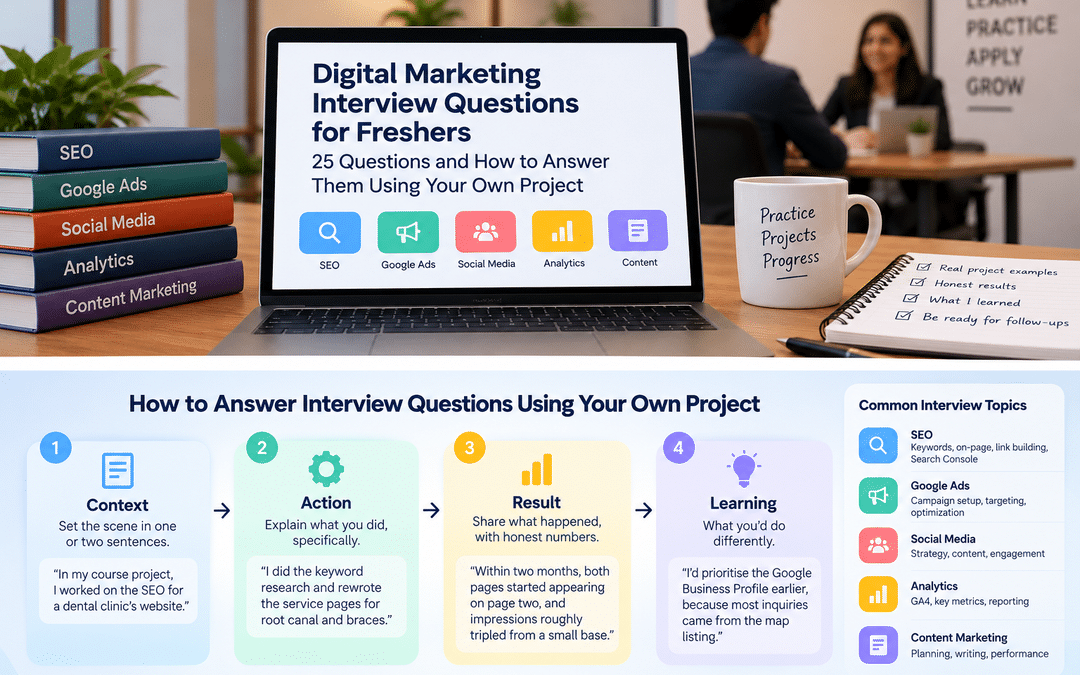
The answer method: Context, Action, Result, Learning
Use this four-part structure for any question where you can draw on a project.
| Part | What to say | Example |
| Context | The project in one sentence | “In my course live project, our team handled SEO for a dental clinic’s website.” |
| Action | What you did, specifically | “I did the keyword research and rewrote the service pages for root canal and braces.” |
| Result | What happened, with honest numbers if you have them | “Within two months, both pages started appearing on page two for local searches, and impressions in Search Console roughly tripled from a very small base.” |
| Learning | What you’d do differently | “I’d prioritize the Google Business Profile earlier, because most inquiries came from the map listing.” |
The learning part is what makes answers stand out. It shows you think about your work, not just complete it.
One rule above all: never invent results. Interviewers often ask follow-up questions or ask you to show your screenshots. Small, honest numbers are far better than impressive invented ones. “Impressions went from 40 to 130 a week” is a perfectly good fresher answer. The sample answers in this guide use a hypothetical project; replace every detail with your own.
How fresher digital marketing interviews usually work
The format varies by company, but most fresher hiring in Indian agencies, startups, and in-house marketing teams follows a similar pattern. This is based on common hiring practice, not a fixed rule.
| Round | What happens | What they’re checking |
| Screening or HR call | A short call about your background, interest, availability, and expectations | Communication, genuine interest, basic fit |
| Technical or functional interview | Questions on SEO, ads, social media, analytics, and tools, often with a manager | Real understanding, not just definitions |
| Assignment or test task | A small task: audit a website, plan a social calendar, write ad copy, suggest a campaign | Whether you can actually do the work |
| Final or founder round | A conversation about attitude, learning ability,y and long-term fit, common in startups | Ownership, curiosity, how you handle feedback |
Agencies often move faster and lean heavily on the assignment. Larger companies may add an aptitude test or group discussion. Startups frequently skip formal rounds and simply ask, “Show me something you’ve done.”
In every format, a real project gives you something concrete to talk about. If you don’t have one yet, build one before you start applying: optimize a friend’s business listing, run a small ad campaign with a few hundred rupees, or grow a niche Instagram page for a month. That alone puts you ahead of many applicants.
General and HR questions
1. Tell me about yourself.
Why they ask: To see whether you can communicate clearly and connect your background to the role.
How to answer: Keep it under a minute. Cover your background briefly, how you got into digital marketing, one project, and what you’re looking for. Skip your full education history.
“I’m a B.Com graduate from Bangalore. During college, I helped run social media for our fest and realized I enjoyed seeing which posts actually brought people in. I then completed a digital marketing course, where my team ran a live project for a dental clinic. I handled the SEO and Google Business Profile. I’m now looking for an SEO or performance marketing role where I can keep working on real accounts and learn from experienced people.”
2. Why do you want to work in digital marketing?
Why they ask: To check that your interest is genuine and that you understand what the work involves.
How to answer: Avoid “it’s a growing field with lots of opportunities”. Everyone says that. Give a specific reason linked to something you’ve done or noticed.
“I like that results are measurable. During my project, I changed the clinic’s page titles and, a few weeks later, saw impressions increase in Search Console. Measuring it and improving it is what I enjoy.”
3. Walk me through a project you’ve worked on.
Why they ask: This is often the most important question in a fresher interview. It shows what you can actually do.
How to answer: Use Context, Action, Result, Learning. Be clear about what you did versus what the team did. Have screenshots ready on your phone or laptop.
“Our team of four worked on a dental clinic in Jayanagar. I owned SEO. I started with keyword research using Keyword Planner and Search Console, found that people searched for treatments plus the area name, and rewrote the three main service pages around that. I also completed and fixed the Google Business Profile categories. Over two months, Search Console impressions rose from a very small base, and calls from the map listing increased according to the profile’s Performance report. Looking back, I’d have fixed the Business Profile in week one rather than week four.”
4. Which area of digital marketing do you want to specialize in?
Why they ask: To see whether you’ve thought about your direction, and whether it matches the role.
How to answer: Name an area, explain why using your project experience, and show openness to learning others. Research the role first, so your answer fits.
“SEO interests me most because I enjoyed the research and the slow build of results in my project. But I also ran a small Google Ads test and want to understand paid search better. In a fresher role, I’d like broad exposure while building depth in SEO.”
5. What are your salary expectations?
Why they ask: To check that your expectations fit their budget.
How to answer: Research typical fresher salaries for the role and city on job portals and salary sites such as Naukri, AmbitionBox, and Glassdoor before the interview. Give a reasonable range based on that research, and show that learning matters to you too. Avoid quoting a number you can’t justify.
“From what I’ve seen for fresher SEO roles in Bangalore, I’d expect something in the range of [your researched range]. I’m flexible, because the learning and the kind of accounts I’d work on matter a lot to me at this stage.”
SEO questions
6. How does Google decide which pages to show for a search?
Why they ask: To test whether you understand the basics beyond buzzwords.
How to answer: Explain the three stages simply: crawling (Google discovers pages), indexing (it understands and stores them), and ranking (it decides which indexed pages best answer a search, using many signals such as relevance, quality,y and usefulness). Then connect it to something you checked.
“In my project, I used Search Console’s Pages report to check that all the clinic’s service pages were indexed. One wasn’t, because no internal links pointed to it. Once we linked it from the homepage, it was indexed within a couple of weeks.”
7. How do you do keyword research?
Why they ask: It’s a core SEO skill, and many freshers only know “use a tool and pick high volume”.
How to answer: Show a process: start with customer language, expand with tools, check intent on the results page, prioritize by relevance and winnability, then map keywords to pages.
“For the clinic, I started with questions patients asked at reception, then expanded them with Google autocomplete and Keyword Planner set to Bangalore. The biggest term, ‘dentist Bangalore’, was dominated by large chains, so I focused on treatment plus area searches like ‘root canal Jayanagar’, which had lower volume but clear intent. I mapped each to one service page.
8. What’s the difference between on-page, off-page, and technical SEO?
Why they ask: A standard check of foundational knowledge.
How to answer: One sentence each, with an example of something you did in each.
“On-page is what’s on the page itself: content, titles, headings, internal links. I rewrote titles and service content. Technical is how well search engines can crawl and load the site: speed, indexing, mobile usability. I fixed the indexing issue and compressed large images. Off-page is reputation outside the site: links, mentions, and, for local businesses, reviews. We started a review request process through WhatsApp.”
9. A page isn’t ranking. What would you check?
Why they ask: To see how you think through a problem, not whether you know the perfect answer.
How to answer: Walk through a logical sequence. Is it indexed? Does it match search intent? How does it compare with what ranks? Is it technically sound? Does it have internal links? Then mention one you’ve actually done.
“First, I’d check in Search Console whether it’s indexed. Then I’d search the target keyword and look at what ranks, to see whether Google wants a guide, a service page, or local results. In my project, a ‘teeth whitening’ page wasn’t ranking because the results were all treatment pages with prices, while ours was a general article. We rewrote it as a service page with a price range, and it started appearing.”
10. If a website’s organic traffic suddenly dropped, what would you do?
Why they ask: To see whether you’d panic or diagnose.
How to answer: Show that you’d check the cause before acting: tracking issues, technical problems, manual actions, seasonality, and Google updates. Mention comparing data in Search Console.
“I wouldn’t change anything immediately. I’d first check whether Search Console also shows the drop, to rule out a GA4 tracking problem. Then I’d check for indexing errors, manual actions, and recent site changes, compare with last year for seasonality, and check whether a Google update was rolling out. Only then would I look at which pages and queries lost traffic.”
Google Ads and paid media questions
11. How does the Google Ads auction work?
Why they ask: Many freshers think the highest bidder always wins. The interviewer wants to know whether you understand quality.
How to answer: Explain that ad position depends on more than the bid. Google considers expected click-through rate, ad relevance,e and landing page experience (summarised as Quality Score), along with context such as the searcher’s device and location. A more relevant ad can beat a higher bid.
“In our small test for the clinic, our root canal ad group had a low Quality Score because the ad sent people to the homepage. When we pointed it to the root canal page and used the treatment name in the headline, the Quality Score improved,d and our cost per click came down.”
12. Explain the keyword match types.
Why they ask: A standard Google Ads question, and one where up-to-date answers stand out.
How to answer: Broad match shows ads for searches related to your keyword’s meaning; phrase match for searches that include its meaning; exact match for searches with the same meaning. Then show you know automation is changing this: with AI Max for Search campaigns, Google applies broad-match behavior more widely, so negative keywords and search term reviews matter even more.
“In our campaign, we started with phrase and exact match because the budget was small. Reviewing the search terms report each week, I added negatives like ‘free’, ‘course ‘, and ‘jobs’, which cut wasted clicks noticeably.”
13. Which metrics would you track for a lead generation campaign?
Why they ask: To see whether you focus on business results or vanity metrics.
How to answer: Start with the business outcome, then work backward: cost per lead and lead quality first, then conversion rate, click-through rate, and cost per click. Mention that conversion tracking must be set up correctly before any of this means anything.
“I’d track cost per lead, but also ask the client which leads became appointments, because cheap leads that never book aren’t useful. In our project, we only tracked form submissions at first, then realized most patients called. Adding call tracking changed which ad group looked best.”
14. How is advertising on Meta different from Google Ads?
Why they ask: To see whether you understand intent.
How to answer: Google Search ads reach people actively searching, so intent is high. Meta ads (Facebook and Instagram) reach people based on interests, behavior, and audiences while they’re scrolling, so you create demand rather than capture it. That changes the creative, the offer, and the metrics you judge.
“For the clinic, Google Ads targeted people already searching for treatments. If we’d used Meta, I’d have promoted something like a free dental check-up camp with a strong visual, because people on Instagram aren’t looking for a dentist at that moment.”
Social media and content questions
15. How would you plan a monthly content calendar for a brand?
Why they ask: Content planning is a common fresher task, and they want to see structure.
How to answer: Start with the goal and audience, define a few content themes (pillars), decide formats and frequency for each platform, plan around key dates, and build in a way to review performance.
“For the clinic’s Instagram, the goal was trust and appointment inquiries. I set three themes: dentist-answered patient questions, behind-the-scenes clinic hygiene, and treatment explainers. We planned three posts and two reels a week, tied some posts to dates like World Oral Health Day, and reviewed which theme got the most saves and DMs at month-end. Patient-question reels clearly did best, so we made more of them.”
16. Which social platform would you recommend for a business, and why?
Why they ask: To test whether you match platforms to audiences instead of saying “all of them”.
How to answer: It depends on who the customer is and how they decide. Give a reasoned answer for the type of business in the role you’re applying for.
“For a local clinic, Instagram and the Google Business Profile matter most, because patients look for trust and proximity. For a B2B software company, LinkedIn would be my first choice, because decision-makers are there and content can build credibility over time. I wouldn’t spread a small team across every platform.”
17. How do you measure whether social media is working?
Why they ask: To check you look beyond likes and follower counts.
How to answer: Separate engagement metrics (reach, saves, shares, comments) from business metrics (profile visits, website clicks, DMs or inquiries, leads). Link social activity to outcomes where possible, for example with UTM links.
“Likes grew steadily, but what mattered for the clinic was inquiries. We added a UTM link in the bio and tracked WhatsApp messages that mentioned Instagram. That showed which posts actually led to appointments.”
18. Look at our Instagram page. What would you improve?
Why they ask: To see whether you’ve researched the company and can give useful, respectful feedback.
How to answer: Always study the company’s channels before the interview. Mention one or two things that work well, then one or two specific, practical improvements, explained by the result they’d achieve. Avoid harsh criticism.
“Your product reels get far more engagement than static posts, which is great. I noticed the bio link goes to the homepage. A link to a page with your current offers might convert better. I’d also test adding customer stories, since your reviews mention the after-sales service a lot, but I don’t see it on your feed.”
Analytics and tools questions
19. Which GA4 reports would you check first for a website?
Why they ask: To see whether you can use analytics to answer business questions, not just open the tool.
How to answer: Name a few reports and the question each answers: Traffic acquisition for where visitors come from, Landing page for which pages start journeys, and Key events for how many inquiries the site produces.
“I’d start with Traffic acquisition, adding key events as a column, to see which channels bring inquiries, not just visitors. For the clinic, organic search brought fewer visitors than Instagram but far more appointment requests. That changed where we focused.”
20. What is a key event (or conversion) in GA4, and how do you set one up?
Why they ask: Tracking is where many campaigns fail, and freshers who understand it are valuable.
How to answer: A key event is an action that matters to the business, such as a form submission or a call click. Mention that GA4 renamed conversions to key events. Then explain one way you set it up.
“For the clinic, the form led to a thank-you page, so I created a generate_lead event in GA4 from views of that page and marked it as a key event. I tested it by submitting the form myself and checking the Realtime report.”
21. What are UTM parameters?
Why they ask: A practical, everyday skill.
How to answer: UTM parameters are tags added to a URL, such as source, medium, and campaign, so analytics tools know exactly where a visit came from. Give an example.
“We added UTM tags to the Instagram bio link and the WhatsApp broadcast link, for example, utm_source=instagram&utm_medium=social&utm_campaign=checkup_camp. That let us see in GA4 which channel brought more bookings for the dental camp.
22. Which tools have you used hands-on?
Why they ask: To gauge how quickly you can start contributing.
How to answer: Be honest about your level with each tool. Separate tools you’ve used on a real project from ones you’ve only seen in a class. Interviewers often follow up with “Show me.”
“On the live project, I used Search Console, GA4, Keyword Planner, Google Business Profile, and Canva regularly. I’ve used Semrush and Screaming Frog for audits in class exercises, but not on a client project yet. I’ve also used ChatGPT and other AI tools for content outlines and ad copy variations, which I always edit and fact-check.”
AI and current trends questions
23. How do you use AI tools in your marketing work?
Why they ask: Almost every team uses AI now. They want to know whether you use it thoughtfully or just paste its output.
How to answer: Give specific tasks where AI saves time, and explain how you check and improve its output. Show judgment about where not to rely on it.
“I use AI tools to brainstorm content angles, draft ad copy variations, and summarise long reports. For the clinic, I generated twenty headline options for an ad, picked the strongest five and edited them for accuracy. I never publish facts from AI without checking them, because I once caught it inventing a statistic about dental health.”
24. How is AI search changing SEO?
Why they ask: To check whether you follow the industry.
How to answer: Mention Google’s AI Overviews and AI Mode, and assistants like ChatGPT. Explain that Google says optimizing for its AI features is still SEO, because AI answers draw on pages its systems already rank. That original, experience-based content matters more than generic articles. Mention that Search Console now reports impressions in AI features.
“Google has said that SEO fundamentals still apply to AI Overviews, because they’re built on pages Google’s systems retrieve. What changes is that generic answers are less valuable, since the AI can summarise them. So I’d focus on content with real experience, like the clinic’s dentist answering actual patient questions.”
25. What recent change in digital marketing have you been following?
Why they ask: To see whether you’re curious and keep learning on your own.
How to answer: Pick one genuine recent development you understand, explain it in two sentences, and say what it means for a business. Prepare this in advance, and make sure your facts are current.
Recent developments a fresher could discuss in late 2026 include GA4’s AI Assistant traffic channel, added in May 2026; Google’s AI Max for Search campaigns becoming the default for new Search campaigns; and Search Console’s generative AI performance report.
“I’ve been reading about GA4 adding an AI Assistant channel this year, which separates visits from tools like ChatGPT and Gemini. For a business, that means you can finally see whether people referred by AI assistants actually convert, although some of those visits still show up as Direct.”
The assignment round and your portfolio
For many fresher roles, the assignment matters more than any single answer. It’s the closest thing to watching you work.
Common assignments
- Audit a website’s SEO and suggest the top five improvements
- Plan a month of social media content for a brand
- Write ad copy for a Google Search campaign, with keywords and negative keywords.
- Suggest a marketing plan for a product launch with a fixed budget. Analyze a sample GA4 or Search Console export and share insights.
How to do them well
Prioritise. A list of forty issues is less useful than five ranked recommendations with reasons. Show that you know what matters most.
Explain your thinking. For each recommendation, say why, and what result you’d expect. Interviewers want to understand how you reason.
Be specific to the business. Generic advice like “post consistently” or “improve page speed” suggests you didn’t look closely. Reference actual pages, posts, or search results.
Keep it clean and short. A tidy two-page document or a short slide deck beats a sprawling file.
Use AI carefully, and be ready to defend every line. Many interviewers can spot generic AI output, and they’ll ask you to explain your recommendations.
Submit on time. Reliability is part of the test.
Your portfolio
A simple portfolio makes every interview easier. It doesn’t need to be a website; a well-organized Google Drive folder or a few pages in a document works. Include:
- One or two project case studies using Context, Action, Result, Learning
- Screenshots of real work: Search Console graphs, ad results, content you created, a GA4 report
- Certifications, such as Google’s free Skillshop certifications
- A short note on what you’d do next on each project
Hide private client information where needed, and only show results you can explain.
Common mistakes freshers make in interviews
Reciting definitions. Textbook answers show you studied, not that you can do the work. Always connect a concept to something you did.
Claiming team results as your own. Interviewers will probe. Say clearly what you did and what the team did.
Inventing or inflating numbers. It’s easy to get caught on a follow-up question. Small, honest results are perfectly acceptable for a fresher.
Not researching the company. Look at their website, social pages, ads, and recent work before the interview. Be ready to say one thing you like and one thing you’d try.
Listing every tool you’ve heard of. Say which tools you’ve used hands-on and which you’ve only seen. Honesty here builds trust.
Outdated knowledge. Talking about Universal Analytics “goals,” Google My Business, or other retired features signals you haven’t kept up. Check that your terms are current.
Having nothing to show. Keep screenshots and your portfolio ready on your phone or laptop.
Not asking any questions. Ask about the accounts you’d work on, who you’d learn from, and what success looks like in the first three months. It shows you’re serious.
Frequently asked questions
How should a fresher prepare for a digital marketing interview?
Work on at least one real project, prepare short answers using Context, Action, Result, Learning, research the company’s channels, review current platform terms, and keep a simple portfolio with screenshots ready to share.
What if I don’t have any project experience?
Create some before applying. Help a local business with its Google Business Profile, run a small ad campaign, start a niche blog or Instagram page, or offer to manage a friend’s social media for a month. Even small projects give you real examples to talk about.
Are certifications enough to get a digital marketing job?
They help, especially free ones from Google and HubSpot, but most employers value practical evidence more. Pair certifications with at least one project you can explain in detail.
What technical questions are asked in a digital marketing interview?
Common topics include how search engines rank pages, keyword research, on-page and technical SEO, Google Ads match types and Quality Score, social media metrics, GA4 reports, key events and UTM tracking. The questions in this guide cover the most frequent ones.
Do fresher interviews include a practical test?
Many do, especially at agencies. Expect a short assignment such as a website audit, a content calendar, or ad copy, usually with a deadline of a day or two.
Should I mention AI tools in my interview?
Yes, if you use them well. Explain specific tasks you use them for and how you check their output. Avoid giving the impression that AI does your thinking for you.
How can I build a project before my first job?
Structured training with live projects is one route. At Web Marketing Academy, students work on live projects as part of the course and finish with a case study they can present in interviews, along with mock interview practice. Self-initiated projects for local businesses or your own site work well too.
