
If you run a business or work in marketing, someone has probably told you that SEO is dead and you now need “GEO”. Or “AEO”. Or both, sold as a separate retainer.
It’s an easy pitch to believe. People really are asking ChatGPT, Gemini, and Google’s AI Mode questions they once typed into a search box. A Bangalore dental clinic owner who used to worry about ranking for “dentist in Indiranagar” now wonders whether ChatGPT will ever mention her clinic.
In May 2026, Google did something it rarely does. It published an official guide on exactly this question, called Optimizing your website for generative AI features on Google Search. It names AEO and GEO directly, and it says which popular tactics you can ignore.
This article explains what the three terms mean, what Google’s guide actually says, and how ChatGPT and other AI assistants work differently. By the end, you should be able to tell a useful AI-search recommendation from an expensive rebrand of ordinary SEO.
SEO, AEO and GEO: what each term actually means
The three acronyms describe overlapping goals, each aimed at a different kind of search result. Here’s the plain version.
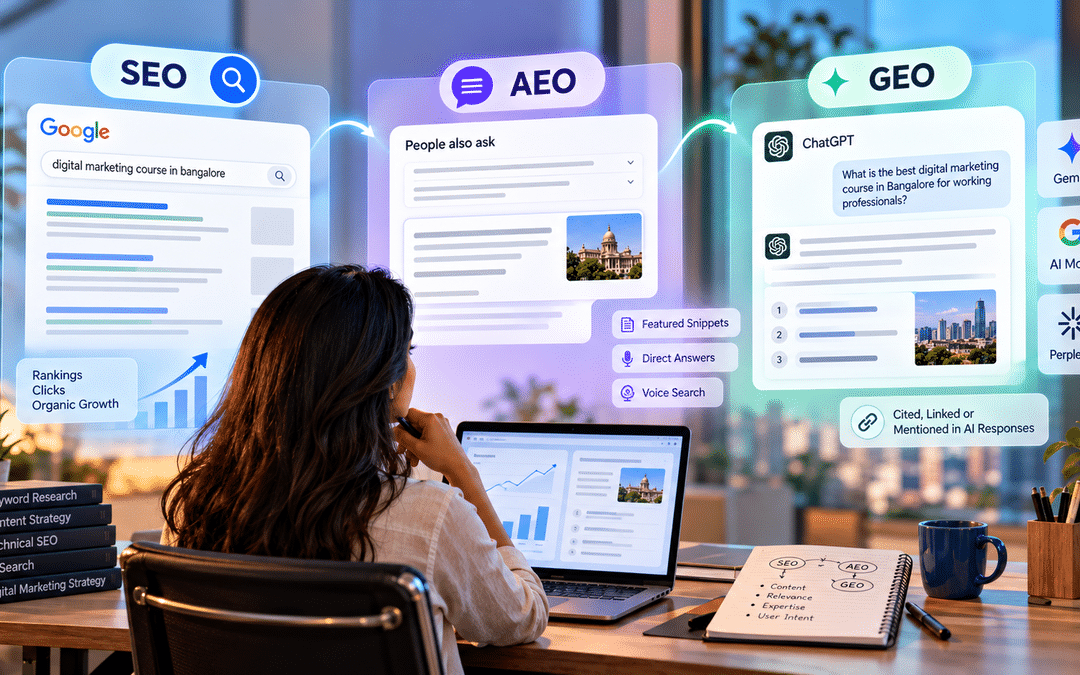
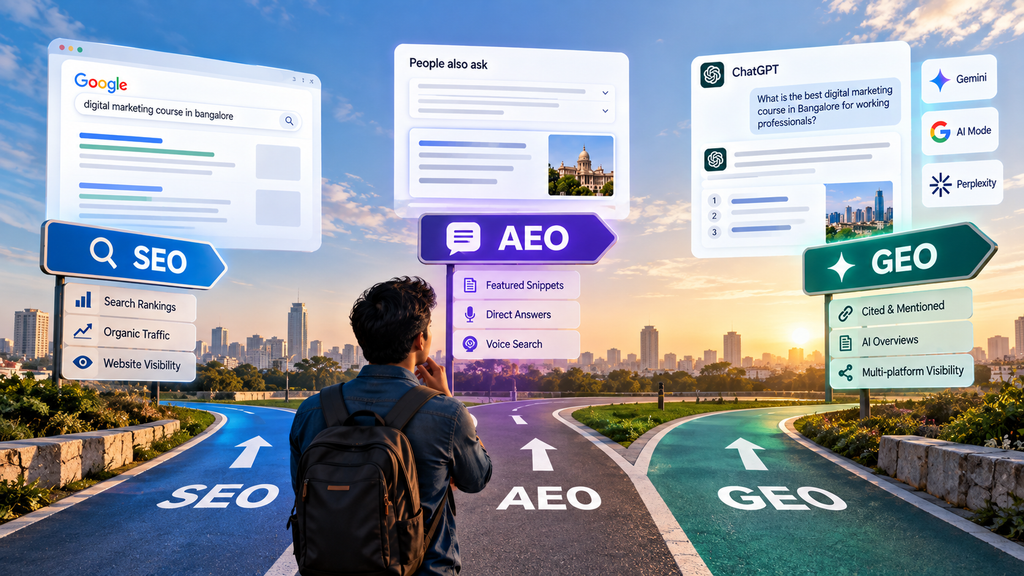
SEO (Search Engine Optimization) is the practice of helping your pages get discovered, understood, and shown by search engines. It covers technical health, content quality, relevance, and credibility. Traditionally, the result was a blue link on a results page.
AEO (Answer Engine Optimization) is an older term than most people realize. It became popular in the featured-snippet and voice-assistant years, when the goal was to become the single answer Google read out or displayed at the top (“position zero”). In practice, AEO meant structuring content so a clear, direct answer could be lifted from your page.
GEO (Generative Engine Optimization) is the newest term. It was coined in a November 2023 research paper, GEO: Generative Engine Optimization, whose lead author, Pranjal Aggarwal, was at IIT Delhi, with co-authors from Princeton University. The paper studied how content creators could improve their visibility inside answers written by AI systems that summarise several sources at once. It was later presented at the KDD 2024 conference.
| SEO | AEO | GEO | |
| Where you want to appear | Search results pages | Featured snippets, voice answers, answer boxes | AI-written answers (AI Overviews, AI Mode, ChatGPT, Perplexity, Gemini) |
| What “winning” looks like | A ranking and a click | Being the quoted answer | Being cited, linked, or mentioned in the AI’s response |
| Origin of the term | Late 1990s | Featured-snippet and voice-search era | November 2023 research paper |
| How it’s measured | Rankings, clicks, traffic | Snippet ownership | Citations and mentions; tools are still immature |
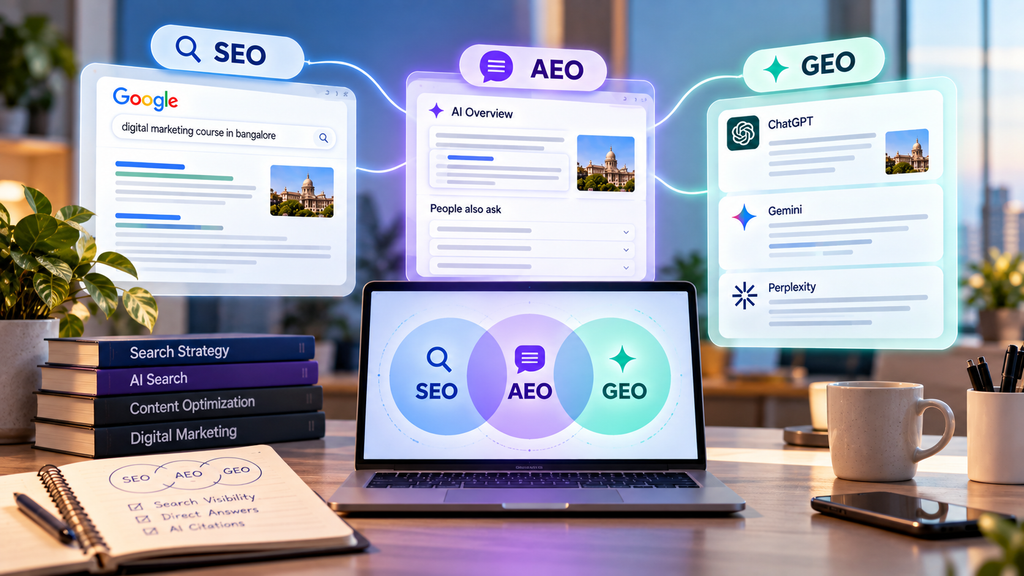
Notice what the table doesn’t show: different ranking factors. The terms describe where you want to appear, not a separate rulebook. That distinction matters for what comes next.
What Google’s guide actually says
Google’s position fits in one line. It says working on generative AI search is “optimizing for the search experience, and thus still SEO.” The guide names AEO and GEO explicitly, then folds both back into SEO.
That isn’t just a branding choice. It follows from how Google builds its AI features.
How AI Overviews and AI Mode find your content
Google describes two mechanisms behind its AI answers.
Retrieval-augmented generation (also called grounding). The AI doesn’t answer from memory alone. Google’s normal ranking systems first retrieve relevant pages from the Search index, and the AI then writes its answer from those pages and links to them. If regular Search wouldn’t retrieve your page, it has little chance of being used in the AI answer.
Query fan-out. The AI quietly runs several related searches to cover the question from different angles. Imagine someone in Bangalore asks AI Mode, “Which digital marketing course suits a working professional?” The system might also look up weekend batch options, online versus classroom formats, and what the syllabus covers. Pages that rank for those sub-questions can all feed into one answer.
Both mechanisms sit on top of the same index and ranking systems as classic Search. That’s why Google says good SEO remains the foundation.
What Google tells you to focus on
Non-commodity content. This is the guide’s biggest emphasis. Google distinguishes between commodity content, which restates common knowledge anyone could write, and non-commodity content, which offers first-hand experience or an expert take.
An Indian example makes the difference obvious. “10 Tips to Choose a Home Loan” is commodity content; thousands of pages say the same thing. “We Compared Floating-Rate Offers from Five Banks for a ₹50 Lakh Loan: Here’s What the Fine Print Changed” is non-commodity content, because it contains something only the author could provide. Google also warns against simply recycling what’s online or what an AI model could easily produce.
Clear structure for human readers: paragraphs, sections, and useful headings. The guide frames this as helping people read, not as a special AI format.
Images and video. AI features can pull in visuals too, so relevant, good-quality images and videos create more ways to appear.
Technical eligibility. To appear in AI features, a page must be indexed and eligible to show with a snippet in normal Search. The site must also be included in generative AI features through a Search Console setting.
Local and product data. AI answers can include local businesses and products. Google points to Google Business Profile and Merchant Center feeds as the way to supply that information. For a salon in Jayanagar or a D2C brand selling on its own website, this is concrete work with a direct payoff.
Measurement. Google recommends the Generative AI performance report in Search Console to see how often your pages appear in AI Overviews and AI Mode. It also warns that no third-party tool has access to Google’s internal ranking or AI systems.
AI agents. The guide briefly notes that AI agents may soon visit websites to complete tasks like bookings or product comparisons. It treats this as something to explore if relevant, not a priority for most sites.
The GEO tactics Google says you can ignore
This is the most useful part of the guide for anyone being sold a GEO package. Google lists several popular tactics that do nothing for Google Search. Note the qualifier each time: for Google. Other AI systems may behave differently, which we’ll come to.
llms.txt and other “AI files”. An llms.txt file is a proposed text file that summarises a website for AI models. Google says Search doesn’t use such files, special markup, or Markdown versions of pages. Googlebot may find and index an llms.txt file, but it treats it like any other file. Creating one won’t hurt your Google visibility, and it won’t help it either.
Chunking content. Some GEO advice says to break articles into short, self-contained blocks so AI can “lift” them. Google says its systems already understand pages that cover several topics, and there’s no ideal page length. Write for your reader.
Rewriting for AI or chasing every keyword variation. You don’t need a special AI writing style. Google’s systems understand synonyms and meaning, so you don’t have to cover every long-tail phrasing.
There’s a sharper warning here too. Creating separate pages for every question people might ask, including likely fan-out queries, mainly to manipulate AI answers can violate Google’s scaled content abuse policy. If an agency proposes publishing 300 near-identical “best X in [area]” pages to get into AI Overviews, this is the policy that page count runs into.
Buying or faking mentions. AI answers draw on what’s said across the web, including blogs, videos, and forums. But Google says it has systems to block spam, and its AI features rely on them. Planting fake Reddit or Quora discussions about your brand is a risk, not a strategy.
Obsessing over structured data. Schema markup isn’t required for AI features, and there’s no special schema for them. Google still recommends it for rich results in regular Search, so keep using it where it makes sense.
What this doesn’t mean
The guide doesn’t say AI search changes nothing. It changes how results look, how people click, and how you should measure visibility. It says that, on Google, you win AI visibility through the same work that wins search visibility: being crawlable, being useful, and saying something others haven’t.
Where ChatGPT and other AI engines differ
Google’s guide only covers Google. ChatGPT, Microsoft Copilot, Perplexity, and others run their own systems, crawlers,s and rules. Semrush’s blog made this point directly when covering the guide: other AI engines may play by different rules.
The fundamentals still carry over. A crawlable, useful, credible page tends to do well everywhere. But a few differences are worth knowing.
1. Different crawlers, and they can be blocked separately
ChatGPT’s search feature relies on OpenAI’s own crawler, OAI-SearchBot. OpenAI’s publisher FAQ says any public website can appear in ChatGPT search, as long as you aren’t blocking OAI-SearchBot.
OpenAI treats search and model training as separate. According to its crawler documentation, each robots.txt setting is independent. GPTBot collects training data; OAI-SearchBot surfaces sites in ChatGPT search. You can allow one and block the other.
This matters because many sites blocked AI bots wholesale in 2023 and 2024, often through a security plugin, hosting setting, or CDN rule. If your robots.txt blocks OAI-SearchBot, you may be invisible in ChatGPT search while ranking perfectly well on Google. Checking this takes two minutes.
Google works differently. There’s no separate “AI search” crawler; AI features use the normal Search index. Google-Extended is a separate control for AI model training and doesn’t affect whether you appear in AI Overviews. Opting out of AI Overviews and AI Mode is a property-level setting in Search Console.
2. Answers don’t always come from a live search
Google’s AI features are grounded in its Search index by design. ChatGPT sometimes searches the web and sometimes answers from what it learned during training. When it answers from memory, what shapes the reply is how your brand has been described across the web over time, not your latest blog post.
This is an industry observation rather than a documented rule, but it explains a common frustration. A business can publish excellent new content and still see ChatGPT describe it using older or incomplete information.
3. llms.txt may matter somewhere, just not on Google
Google says it ignores llms.txt, while noting that other services might use such files. If your developer can add one in ten minutes, the downside is small. But paying an agency a monthly fee for llms.txt “optimization” is hard to justify on current evidence.
4. Measurement is uneven across platforms
Each platform gives you a different, partial view.
| Platform | Where AI answers draw from | How to control access | What you can measure |
| Google AI Overviews and AI Mode | Google’s Search index | Search Console generative AI setting; normal robots.txt and noindex | Generative AI performance report: impressions, no clicks at launch |
| ChatGPT search | OpenAI’s search crawler (OAI-SearchBot), plus model knowledge | Allow or block OAI-SearchBot and GPTBot separately in robots.txt | No webmaster console; OpenAI says you can track ChatGPT referral traffic in analytics tools like GA4 |
| Microsoft Copilot and Bing AI answers | Bing’s index | Bing Webmaster Tools and robots.txt | AI Performance report: cited pages, citation trends and the grounding queries that led to citations |
Bing is ahead on reporting. Its dashboard shows which queries led Copilot to cite your pages, something Google’s report doesn’t yet reveal. For Indian businesses that ignore Bing because of its small search share, that’s a reason to verify your site there anyway.
5. Results vary more
Ask ChatGPT the same question twice, and you may get different brands in the answer. Personalization, conversation history, and the model’s reasoning all play a part. Any GEO report showing a single “ranking” in ChatGPT is simplifying something that doesn’t behave like a ranking.
A practical framework: four layers of AI search visibility
Rather than treating SEO, AEO, and GEO as three separate projects, think in four layers. Each layer depends on the one before it.
Layer 1: Access. Can the systems reach your content at all? Check that Google can index your key pages, that your robots.txt isn’t blocking OAI-SearchBot or Bingbot, and that your site is included in generative AI features in Search Console. This layer is binary. If it fails, nothing else matters.
Layer 2: Substance. Is there anything on your pages worth citing? This is where Google’s non-commodity content principle lives. Original numbers, first-hand experience, clear explanations, and a specific point of view give an AI system a reason to use your page over a hundred similar ones.
Layer 3: Presence. What does the wider web say about you? Reviews, your Google Business Profile, mentions in credible publications, genuine discussions,s and consistent business details all shape how AI systems describe you. The word that matters is genuine; Google explicitly warns that fake mentions don’t help.
Layer 4: Measurement. Are you tracking what you can? Use Search Console’s generative AI report, Bing’s AI Performance report, and AI referral traffic in GA4. Supplement these with manual checks: a fixed set of prompts you run each month across ChatGPT, Gemini, and AI Mode.
Worked example: a physiotherapy clinic in HSR Layout
This is a hypothetical scenario, but it reflects a common situation for Bangalore service businesses.
The clinic ranks reasonably well on Google for “physiotherapy in HSR Layout”. The owner asks ChatGPT, “Which physiotherapy clinics in HSR Layout are good for sports injuries?” and the clinic doesn’t appear. An agency offers a ₹40,000-a-month GEO package.
Working through the layers first costs far less:
- Access. The developer finds that a security plugin added a rule blocking all AI crawlers, including OAI-SearchBot. Fixing it takes minutes.
- Substance. The website has a generic “Our Services” page. The clinic adds a page on its approach to ACL rehabilitation for recreational runners and footballers, written by its lead physiotherapist, with typical recovery stages and what patients do at each one. Nothing on competitors’ sites looks like it.
- Presence. The Google Business Profile lists the wrong categories and has few recent reviews. The clinic fixes the categories, starts asking satisfied patients for reviews, and gets listed accurately on the directories patients actually use.
- Measurement. The team sets up a monthly check of ten prompts and tracks AI referrals in GA4 and impressions in Search Console’s generative AI report.
None of this is “GEO” in the sense the agency meant. All of it would improve both Google rankings and AI visibility. That’s the practical meaning of Google’s statement that it’s still SEO.
Common mistakes
Treating GEO as a replacement for SEO. On Google, AI answers are built from pages its normal systems retrieve. Cutting SEO effort to fund “GEO” weakens the thing AI visibility depends on.
Mass-producing question pages. Turning every fan-out query into a thin page looks clever in a spreadsheet. Google names this pattern as scaled content abuse. It also dilutes your site’s quality.
Blocking all AI bots without thinking it through. Blocking training crawlers is a legitimate business choice. Accidentally blocking search crawlers like OAI-SearchBot means disappearing from ChatGPT search. Decide deliberately, crawler by crawler.
Trusting tools that claim insider access. Google states that no third-party tool can see its internal ranking or AI systems. AI-visibility tools can still help track prompts over time, but treat their scores as estimates.
Judging success by one screenshot. A single ChatGPT answer that mentions you, or doesn’t, proves little. Track a fixed set of prompts over months before concluding.
Ignoring local and product data. For many Indian SMEs, the fastest AI-visibility win isn’t content. It’s a complete Google Business Profile or an accurate Merchant Center feed, both of which Google says can appear in AI responses.
What this means if you’re building marketing skills
If you’re a student, a fresher, or a working professional moving into digital marketing, the new acronyms can make it feel like you’re always one step behind. Google’s guide is reassuring. The skills that matter for AI search are mostly the skills that always mattered in SEO, applied with more care.
A few are worth deliberate practice:
- Technical fundamentals. Reading a robots.txt file, understanding indexing, and using Search Console properly. The crawler question alone shows why these basics still matter.
- Writing non-commodity content. Interviewing a subject expert, finding a real number, or documenting a real process is harder than prompting a chatbot for 1,500 words: AI systems and readers also reward it.
- Local and product data. Setting up and maintaining Google Business Profiles and Merchant Center feeds is practical, in-demand work for Indian SMEs and D2C brands.
- Honest measurement. Knowing what each report can and can’t show, and explaining that clearly to a client or manager.
These are hands-on skills, learned best by working on real websites rather than slides. That’s the approach behind Web Marketing Academy’s instructor-led training in Bangalore, where learners work on live projects with tools like Search Console, Google Business Profile, and AI content tools. Whichever way you learn, focus on the fundamentals first; the acronyms will keep changing.
Frequently asked questions
Is GEO different from SEO?
For Google, no. Google’s official guide says optimizing for its generative AI features is still SEO because those features are built on its core ranking and quality systems. For other platforms like ChatGPT, the fundamentals overlap heavily, but crawler access and measurement differ.
What is the difference between AEO and GEO?
AEO (answer engine optimization) grew out of featured snippets and voice assistants, where the goal was to be the one answer shown or read aloud. GEO (generative engine optimization) focuses on being cited in AI-written answers that combine several sources. In practice, people often use the two terms interchangeably.
Do I need an llms.txt file?
Not for Google. Google says Search ignores llms.txt files, and that having one neither helps nor hurts. Some other AI services may use them, so adding one is low-cost, but it isn’t a priority.
How do I get my website to show up in ChatGPT?
Start by making sure your robots.txt doesn’t block OAI-SearchBot, which OpenAI says is needed to appear in ChatGPT search. Then focus on the same things that help everywhere: useful, original content; accurate business details; and a genuine reputation across the web.
Can I see how my site performs in Google’s AI Overviews?
Yes. Search Console’s Generative AI performance report shows impressions in AI Overviews and AI Mode. At launch, it showed impressions only, not clicks.
Does structured data help with AI Overviews?
Google says structured data isn’t required for AI features and there’s no special schema for them. It still recommends structured data for rich results in regular Search.
Should I hire a GEO agency?
Judge the proposal, not the label. Ask what the agency will actually do. If the plan is crawler access, original content, local and product data, and honest measurement, it’s sound SEO work, whatever it’s called. If it centers on llms.txt files, mass-produced question pages, or planted mentions, Google’s guide says those won’t help on Google.
Publishing notes (not for the live post)
| Field | Recommendation |
| Primary keyword | GEO vs SEO |
| Secondary keywords | AEO vs GEO, generative engine optimization, how to show up in ChatGPT, llms.txt SEO, AI Overviews optimization |
| Search intent | Informational, with some commercial investigation (readers evaluating GEO services) |
| Meta title (60 chars) | GEO vs AEO vs SEO: What Google’s AI Search Guide Really Says |
| Meta description (148 chars) | Google says optimizing for AI search is still SEO. Here’s what its 2026 guide says, which GEO tactics to ignore, and where ChatGPT works differently. |
| Suggested slug | /digital-marketing-blogs/geo-vs-aeo-vs-seo/ |
| Schema | Article plus FAQPage for the FAQ section |
