
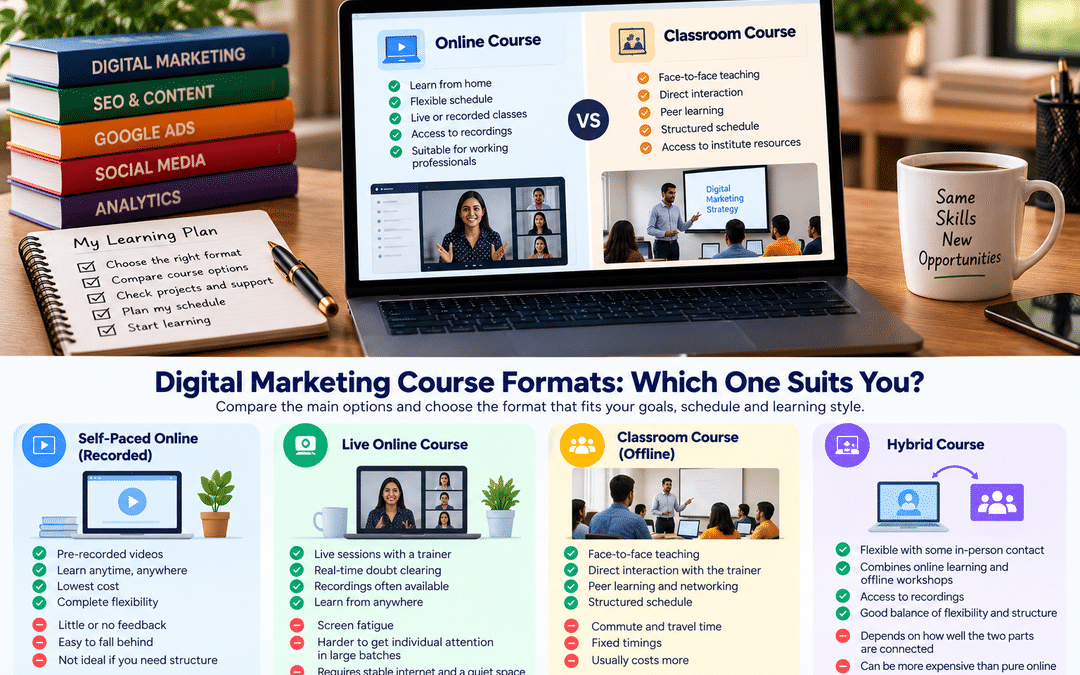
“Should I do the course online or in a classroom?” is usually one of the first questions people ask when they decide to learn digital marketing. It’s a fair question. A classroom course in Bangalore means fixed timings and a traffic-filled commute. An online course lets you study from home, often after a long workday.
The format matters, but not always in the way people expect. A badly designed classroom course with 50 students and no real projects can be worse than a well-run live online course. A recorded online course with no feedback can be excellent for a disciplined marketer filling one gap, and frustrating for a fresher starting from zero.
This guide compares the main formats honestly: self-paced, live online, classroom, and hybrid. It explains what actually differs between them, which suits different kinds of learners, and which questions to ask before paying for either. It’s written for freshers, working professionals, career switchers, and business owners in Bangalore and beyond.
The four formats: “online” means more than one thing
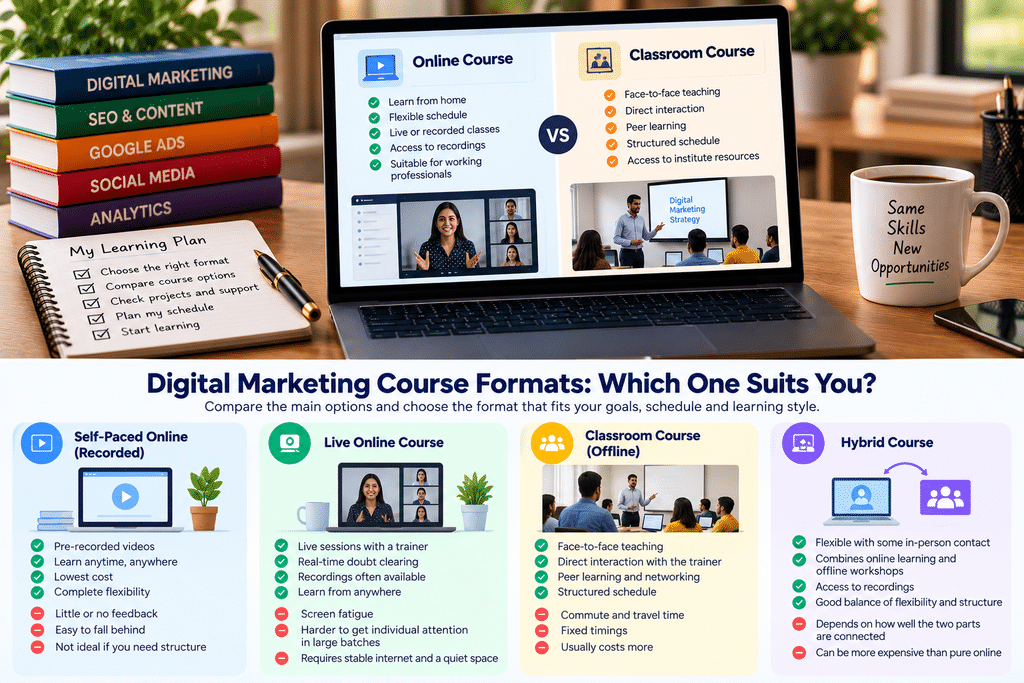
The online vs classroom question is really a choice between four formats. Many people compare a classroom course with a recorded video course and call it “online”, when a live online course would be a fairer comparison.
| Format | How it works | Typical strengths | Typical weaknesses |
| Self-paced (recorded) | Pre-recorded videos you watch whenever you like | Lowest cost, complete flexibility | Little or no feedback; easy to fall behind or stop |
| Live online | Scheduled live sessions with a trainer over video, often with recordings available | Real-time teaching from anywhere; questions answered live | Screen fatigue; harder to get individual attention in large batches |
| Classroom (offline) | In-person sessions at an institute, at fixed times | Face-to-face feedback, peer learning, structure | Commute; fixed timings; usually costs more |
| Hybrid | A mix: classroom sessions with online options, or online with occasional in-person workshops | Flexibility with some in-person contact | Depends heavily on how well the two parts are connected |
When comparing courses, first check which format each one actually is. “Online” on a brochure can mean anything from a library of videos to small live batches with weekly feedback.
Side-by-side: what actually differs
| Factor | Self-paced | Live online | Classroom |
| Feedback on your work | Rare | Possible, depends on batch size | Usually easiest to get |
| Help when you’re stuck | Forums or email, often slow | During sessions, or via screen sharing | A trainer can look at your screen directly |
| Accountability | Entirely on you | Fixed session times help | Fixed times plus face-to-face expectations |
| Learning from peers | Minimal | Some, through breakout discussions and group work | Strong: conversations, group projects, shared problems |
| Flexibility | Complete | Moderate: fixed sessions, but no commute | Lowest: fixed times and location |
| Travel time and cost | None | None | Depends on distance and traffic |
| Fee | Lowest | Usually lower than classroom | Usually highest, partly due to venue costs |
| Revision | Rewatch anytime | Recordings often available | Depends on whether sessions are recorded or notes provided |
| Distractions | High at home | Moderate | Lowest |
| Group live projects | Rarely included | Possible, coordinated online | Easier to coordinate in person |
| Tech requirements | Device and internet | Stable internet, laptop, quiet space | Usually a laptop; Wi-Fi at venue |
What matters more than format
The table shows tendencies, not rules. A small, well-run live online batch can give more feedback than a crowded classroom. What usually matters more than the format itself:
- Batch size. Fewer students per trainer means more individual attention, in any format.
- Live projects. Working on a real website, campaign, or business teaches far more than watching demonstrations.
- Feedback. Someone reviews your keyword research, ad copy, or audit and tells you what to fix.
- The trainer. A practitioner who runs real campaigns brings current knowledge.
- Interview and job support, if that’s why you’re learning.
If two courses differ on these, they’ll likely differ more in outcome than any online-versus-classroom gap would suggest.
Which format suits you?
| If you are… | Often the best fit | Why |
| A fresher starting from zero, aiming for a first job | Classroom, or a small live online batch with live projects | You need structure, feedback, and a portfolio, and you benefit from learning alongside peers |
| A working professional with a full-time job | Live online, or classroom at weekends or evenings if travel is manageable | Fixed sessions keep you consistent without adding a long commute after work |
| Switching careers at 30+ | Live online or classroom with real projects and interview support | Proof of work and accountability matter more than flexibility |
| A business owner wanting to manage your own marketing | Live online, or a short classroom program focused on practical setup | You need applied skills for your own business, at times that fit around it |
| Living outside Bangalore, or in a city without good options | Live online | You get access to trainers without relocating |
| An experienced marketer filling one gap | Self-paced or a short live course | You already have the foundations and can learn one topic independently |
| Someone who struggles with self-discipline | Classroom | Fixed times and in-person expectations make it harder to drift |
| Someone who learns by asking lots of questions | Classroom or small live online batches | Real-time interaction matters more than recordings |
A quick self-check
Answer these honestly:
- Have you started and abandoned an online course before?
- Can you reliably protect 8 to 10 hours a week, at fixed times?
- How long would it take you to reach the classroom at peak traffic?
- Do you need a portfolio and job support, or just the knowledge?
- Do you learn better alone or with others around you?
If you’ve abandoned online courses before, struggle to protect time, or need job-ready proof, lean towards classroom or small live batches. If the commute would be long and you’re self-motivated, live online usually wins.

Questions to ask about any online or classroom course
For any format
- How many hours of live, trainer-led teaching are included?
- What’s the maximum batch size?
- Will I work on a live project, on a real website or business?
- Who are the trainers, and do they currently work on real campaigns?
- Will someone review and give feedback on my work?
- What’s the total fee including GST, and what’s the refund or deferral policy?
- What interview and job support is included?
Extra questions for online courses
- Is it live, recorded, or a mix? How many live sessions each week?
- Are cameras and participation expected, or can people stay silent?
- How do I get help between sessions, and how quickly do replies come?
- How are group projects run online?
- Are sessions recorded if I miss one?
- Can I attend a sample live session before enrolling?
Extra questions for classroom courses
- Where exactly is the venue, and how close is it to public transport?
- What are the session timings, and are there weekday and weekend batches?
- If I miss a session, can I join another batch, watch a recording, or get notes?
- Can I switch to online if my situation changes partway through?
- Can I visit and sit in on a class before enrolling?
Our guide to digital marketing course fees in Bangalore has a fuller checklist of questions about fees, placement, and fine print.
Bangalore realities: commute, timings and budgets
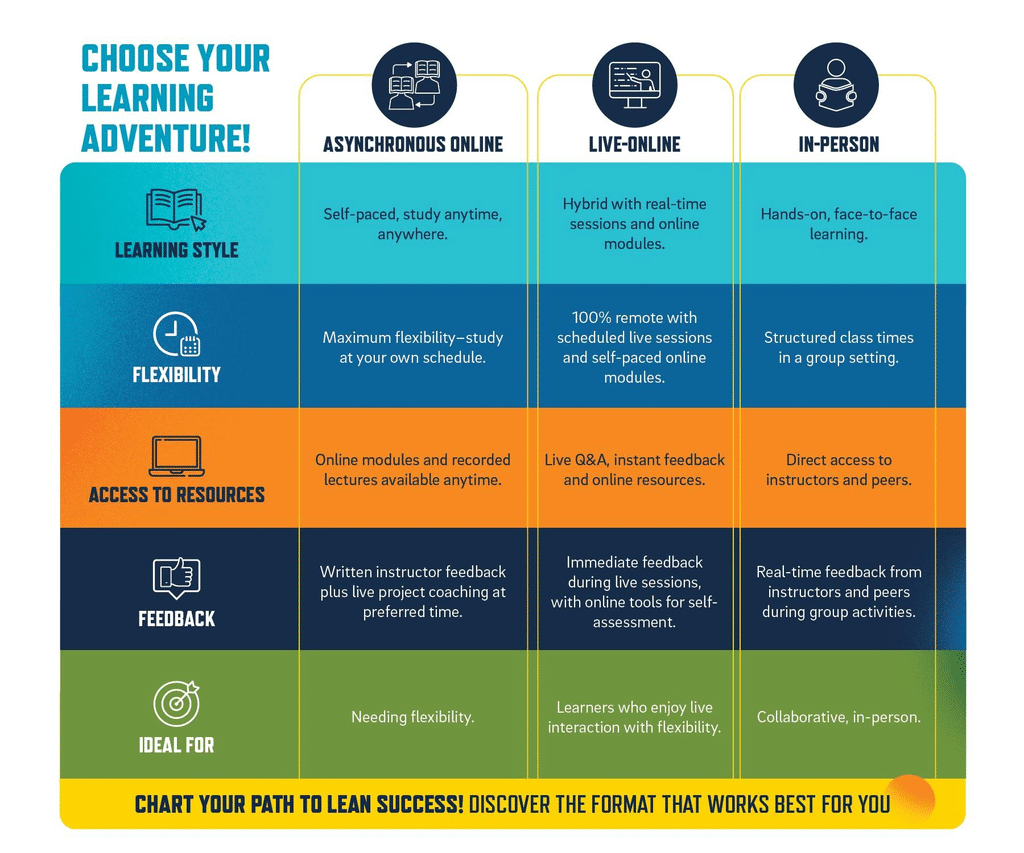
For anyone choosing a classroom course in Bangalore, the commute deserves serious thought. A short distance on a map can take much longer at peak hours.
Count the travel time honestly.y
A simple calculation helps. Suppose a course has two sessions a week for four months, and your round trip takes two hours:
| Calculation | Total | |
| Sessions | 2 a week × about 17 weeks | About 34 sessions |
| Travel time | 34 sessions × 2 hours | About 68 hours |
That’s close to two full working weeks spent in traffic, plus travel costs. For some people, it’s worth it for face-to-face learning. For others, it’s the reason they stop attending.
Things that reduce the burden:
- Choose an institute near public transport. A venue close to a Namma Metro station is often far easier to reach than one that requires a long road journey.
- Pick batch timings that avoid your worst traffic, such as weekend sessions or early starts.
- Look for hybrid options, so you can join online on days when travel isn’t practical.
Fit it around work
Many Bangalore professionals work long or irregular hours, especially in IT, startups, and client-facing roles. Before choosing a weekday evening batch, look honestly at the last month: how many evenings were you actually free by 7 pm? Weekend or live online batches are often more realistic.
Compare value, not just fees.
Classroom courses usually cost more than online ones. Compare them by cost per live, trainer-led hour and what’s included, such as batch size, projects, feedback, and job support, rather than the headline fee alone.
Where Web Marketing Academy fits
Web Marketing Academy offers both formats: instructor-led classroom training in Indiranagar and an online digital marketing course for learners who can’t attend in person. Classroom batches are capped at eight students, and learners work on live projects. The digital marketing course costs ₹49,000 plus GST [TO CONFIRM: whether the online course fee and format differ].
If you’re unsure which format suits you, use the questions above with WMA or any other institute, and ask to attend a demo session in the format you’re considering. You’re welcome to contact WMA for a counseling call.
Common mistakes when choosing a format
Comparing a classroom course with a recorded course and calling both “courses”. Live online is the fairer comparison with classroom training. Recorded courses are a different product.
Choosing only on price. The cheapest format isn’t good value if you stop halfway or finish without a portfolio.
Underestimating the commute. Many classroom learners attend faithfully for a few weeks, then start missing sessions once work and traffic catch up.
Overestimating self-discipline. If you’ve abandoned online courses before, a fixed schedule and in-person accountability may be worth paying for.
Ignoring batch size. A classroom of 50 can offer less attention than a live online batch of 10.
Assuming online means no projects. Good live online courses include real projects and feedback. Ask what’s included, regardless of format.
Not trying it first. Attend a demo session in the exact format you’ll take. A short trial tells you more than any brochure.
Frequently asked questions
Is an online digital marketing course as good as a classroom course?
It can be, if it’s live, has a small batch, includes real projects, and gives feedback on your work. Recorded courses suit some learners but usually offer less support. Compare courses on these factors rather than on format alone.
Do employers care whether I studied online or offline?
Most employers care far more about what you can do, shown through projects, case studies and interview performance, than about how you learned it.
Is a classroom course better for freshers?
Often, because freshers usually benefit from structure, face-to-face feedback and peer learning. A small, well-run live online course can also work well if it includes live projects and job support.
Which is cheaper, online or classroom?
Online courses are usually cheaper, partly because they don’t carry venue costs. Compare the total fee including GST, the number of live hours, and what’s included, not just the headline price.
Can I switch from classroom to online partway through?
Some institutes allow this; others don’t. Ask before enrolling, especially if your job or location might change.
Can I do live projects in an online course?
Yes, in well-designed live online courses. Ask how projects are organized, whether you’ll work on a real website or business, and how feedback is given.
What is a hybrid digital marketing course?
A hybrid course combines classroom and online learning, for example, in-person sessions with the option to join online, or online sessions with occasional in-person workshops. It suits people who want some face-to-face contact without attending every session in person.
How do I decide between online and classroom?
Consider your discipline, commute, schedule, and goals. Then attend a demo session in each format you’re considering, and ask about batch size, live projects, and feedback.
