
“Am I too old to start in digital marketing?” It’s one of the most common questions from people in their thirties who are tired of sales targets, night shifts, repetitive support tickets, or the limits of a teaching job.
The honest answer: no, 30+ isn’t too late, but it isn’t the same as starting at 22 either. You’ll likely be competing with freshers for entry-level roles; you may have EMIs, rent, or family responsibilities that make a long unpaid gap impossible, and you have less time to waste on courses that don’t lead anywhere.
You also bring things most freshers don’t: years of dealing with customers, deadlines, targets, managers, difficult conversations, and real business problems. In marketing, those matter. The challenge is translating that experience into a role employers will hire you for, and building enough practical proof that they believe you can do the work.
This guide gives you a realistic plan for that. It maps common backgrounds, including sales, IT support, teaching, and BPO or customer support, to the digital marketing roles they fit best, and lays out a six-month plan you can follow while still working. It doesn’t promise a quick switch or a specific salary. It aims to help you make the move with your eyes open.
What’s different about switching at 30+
Your advantages
You understand customers. If you’ve sold, supported,d or taught people, you know how they think, what objections they raise,se and what makes them act. Marketing is built on that understanding.
You’ve worked inside a business. You know how targets, budgets, approvals, and managers work. Freshers often don’t.
You communicate like a professional. Writing clear emails, handling a difficult client,t and presenting to a manager are skills many entry-level candidates are still learning.
You can bring domain knowledge. Years in banking, IT services, education, healthcare, or retail make you more useful to companies marketing in those sectors.
You’re usually more committed. A deliberate career change at 32 tends to be taken more seriously than a fresher’s first experiment.
The real constraints
Entry-level roles may pay less than you earn now. This is the hardest part for many people. A switch can mean a temporary pay cut, especially if you move into a junior role. Plan for it rather than hoping it won’t happen.
Less time to learn. Full-time study may not be possible with a job and family. Learning has to fit around work.
Some employers prefer freshers for junior roles. Not all, but some. Targeting the right kind of employer matters, and later sections cover how.
You can’t afford to drift. Watching course videos for a year without building anything is a common trap. Practical proof is what moves you forward.
None of these is a reason not to switch. They’re reasons to switch with a plan.
Map your background to digital marketing roles.
Digital marketing isn’t one job. It’s a group of roles that suit different strengths. Starting with a role that builds on what you already do shortens the switch.
| Background | Strengths you already have | Roles that often fit | Learn these first |
| Sales (field sales, inside sales, real estate, insurance, B2B) | Understanding buyers, handling objections, working to targets, follow-up discipline | Performance marketing (Google and Meta ads), lead generation, CRM and marketing automation, B2B marketing | Google Ads, Meta Ads, landing pages, conversion tracking, CRM basics |
| IT support (helpdesk, system admin, QA, technical support) | Troubleshooting, technical comfort, logical problem-solving, documentation | Technical SEO, marketing analytics, marketing operations, web and tracking setup | SEO audits, Search Console, GA4, Google Tag Manager, WordPress |
| Teaching (school, coaching, training, tutoring) | Explaining clearly, structuring information, writing, audience awareness, presenting | Content marketing, SEO content, social media, edtech marketing, email marketing | Content strategy, SEO writing, social media planning, video basics |
| BPO and customer support (voice, chat, email support, quality) | Customer empathy, handling volume, process discipline, written communication, knowing common complaints | Social media management, community management, email and WhatsApp marketing, customer experience and retention | Social media tools, content calendars, email platforms, WhatsApp Business, basic analytics |
How to read this table
These are starting points, not limits. A former teacher can become an excellent performance marketer, and a former salesperson can write great content. But your first role is easier to win when you can tell an employer, “Here’s why my background makes me good at this.”
For example:
- Sales to performance marketing: “I spent six years converting leads into customers. Now I want to generate those leads more efficiently through ads.”
- IT support to technical SEO: “I troubleshoot systems for a living. Technical SEO is troubleshooting why websites aren’t being found.”
- Teaching to content marketing: “I’ve spent years making complex topics simple for students. That’s what good content does for customers.”
- BPO to social media and retention: “I’ve handled thousands of customer conversations. I know what frustrates customers and what earns their loyalty.”
Other backgrounds work too. People from accounts or finance often suit analytics; HR professionals often suit employer branding and recruitment marketing; operations staff often suit marketing operations.

Choosing your first role, and the bridge-job route
There’s more than one way into digital marketing. For people switching at 30+, the routes that use existing experience usually work best.
| Route | How it works | Advantages | Watch out for |
| Internal move | Move into the marketing team at your current employer | You keep your seniority, network, and often your salary band; the company already trusts you | Requires a marketing team and a supportive manager |
| Industry switch, same sector | Join a marketing team in the industry you know, such as insurance, IT services, or education | Your domain knowledge is a genuine selling point | Fewer openings than generalist roles |
| Agency | Join a digital marketing agency in a junior or associate role | Fast learning across many clients and tools | Often lower pay at entry level, tight deadlines |
| SME or startup | Become the marketing person, or one of a few, at a small business | Broad responsibility quickly; experience valued | Less structured training; you may be the only marketer |
| Freelance or part-time | Take small projects while keeping your job | Builds proof and income without quitting | Inconsistent work; harder to learn without mentors |
The most underrated option: move inside your company
If your employer has a marketing team, start there. Tell your manager and the marketing head that you’re building digital marketing skills. Offer to help with something specific: writing case studies from your sales experience, analyzing support complaints for content ideas, or helping with a product webinar.
This is the “bridge job” approach: a role or project that sits between your current work and marketing. A salesperson who starts managing the company’s lead follow-up process and then its ad campaigns has switched careers without a gap or a pay reset.
Pick one direction for your first role.
It’s tempting to apply for every digital marketing job. You’ll get further by choosing one direction, such as performance marketing, SEO, O or content, for your first role, and building your learning, projects,s and resume around it. You can broaden later.
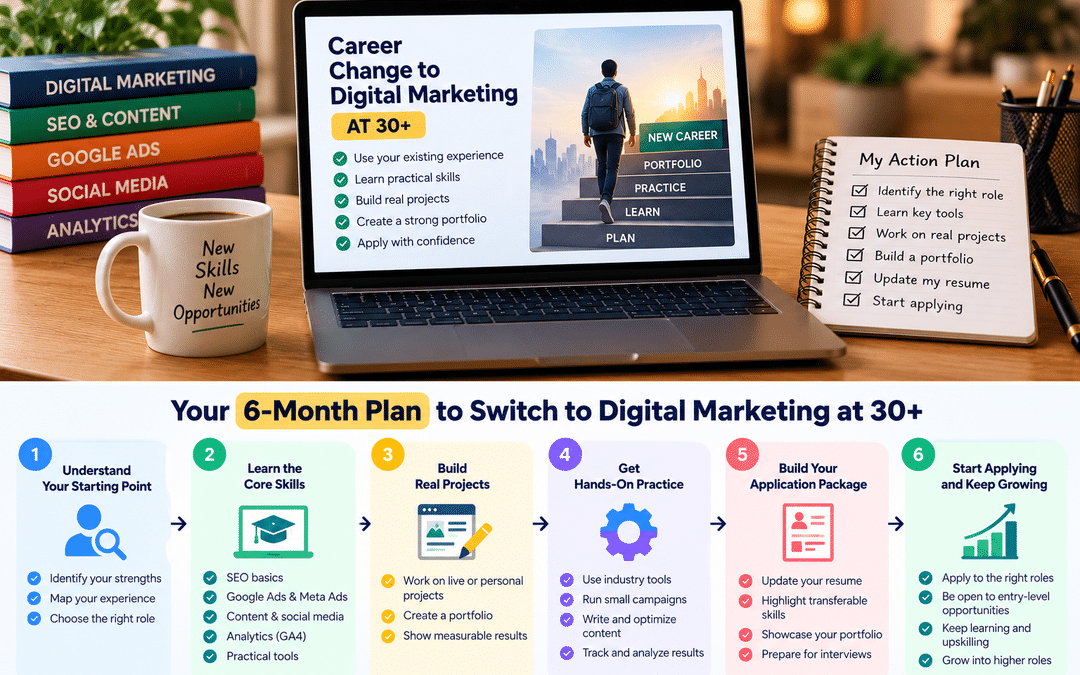
A six-month plan you can follow while working
This plan assumes around 8 to 10 hours a week alongside a full-time job: a few evenings plus part of the weekend. Some people move faster, others need longer. What matters is steady progress with something to show at the end.
| Month | Focus | By the end of the month, you should have |
| 1 | Foundations and direction | A clear picture of how SEO, ads, social, content, email and analytics fit together; one or two free certifications, such as Google’s Skillshop courses; a chosen direction for your first role |
| 2 | Core skills in your direction | Hands-on practice with the main tools, for example Keyword Planner, Search Console and GA4 for SEO, or Meta Ads Manager and Google Ads for performance marketing |
| 3 | First real project | A project on a real website or account: your own site, a friend’s business, a relative’s shop, or a non-profit |
| 4 | Second project and depth | A second, more ambitious project, plus greater skills such as tracking setup or content strategy |
| 5 | Portfolio and visibility | Two written case studies, an updated LinkedIn profile positioned for your target role, and conversations with people already doing the job |
| 6 | Applications and interviews | Targeted applications, practice for assignment rounds, and possibly a freelance or part-time project |
Self-study or a course?
Both can work. Self-study is cheaper but requires discipline and makes it harder to get feedback. A structured course costs more but gives you a sequence, deadlines, feedback from trainers, and, in good programs, live projects.
If you choose a course, judge it on what you’ll build, not how many modules it lists. For a career switcher, the most valuable features are real projects, feedback on your work, timings that fit around your job, and genuine help preparing for interviews. Our guide to digital marketing course fees in Bangalore includes questions to ask any institute before paying.
Protect the time
The plan fails most often in month two or three, when work gets busy and evenings disappear. Block fixed slots in your calendar, tell your family what you’re doing, and set a small weekly goal, such as finishing one audit or launching one campaign, rather than vague “study time”.
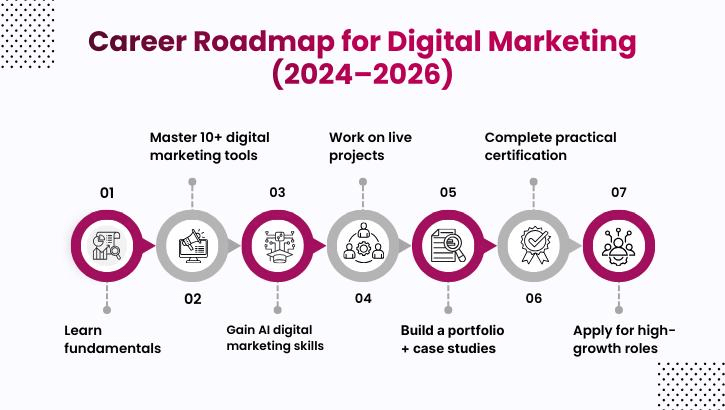
Building proof: projects and a portfolio
For a career switcher, a portfolio does more than a certificate. It answers the employer’s real question: “Can this person do the work, even without marketing experience on paper?”
Project ideas by direction
| Direction | Project ideas |
| SEO | Audit a local business website and implement fixes; build a small niche blog and grow its search impressions; optimize a Google Business Profile |
| Performance marketing | Run a small Google or Meta ads campaign for a local business, with conversion tracking set up; test two offers and report the results |
| Content marketing | Write a content plan and five articles for a small business; repurpose one article into social posts and an email |
| Social media | Manage a small brand’s Instagram for two months, with a content calendar and monthly report |
| Analytics | Set up GA4 key events for a site and build a simple monthly dashboard with insights |
| Email and WhatsApp | Build a welcome sequence or broadcast plan for a small business, and measure replies or clicks |
Small businesses near you, such as a clinic, café, tutor or boutique, are often happy to let someone help for free or a small fee, especially if you explain clearly what you’ll do. Run any ad project with a small budget the business agrees to.
Use your current job.
Your existing role can produce marketing proof:
- Sales: analyze which lead sources close best, or write case studies from customer wins.
- IT support: improve the company’s help center content or fix technical issues on the website.
- Teaching: create short educational videos or a newsletter for parents or students.
- BPO: turn common customer questions into FAQ content, or summarise complaint themes for the marketing team.
Write case studies, not just lists.
For each project, write a one-page case study: the context, what you did, the results with honest numbers, and what you’d do differently. Include screenshots. Our interview questions guide explains this Context, Action, Result, Learning format in detail.
Two strong case studies are more convincing than ten certificates.
Getting hired: resume, positioning, interviews and freelancing
Rewrite your resume for the role you want
A career switcher’s resume should not read like a sales or support resume with “digital marketing course” added at the bottom.
- Start with a summary that explains the switch: “Sales professional with seven years of B2B experience, now specializing
- in performance marketing. Ran Google and Meta campaigns for two local businesses with full conversion tracking.”
- Put projects near the top, with results, tools, and links to case studies.
- Reframe past achievements in marketing terms. “Exceeded targets” becomes “Converted 22% of inbound leads in a team averaging 15%, and identified the lead sources with the highest close rates.” Use only real numbers.
- List tools honestly, separating those you’ve used on real projects from those you’ve only studied.
Position yourself on LinkedIn.
Update your headline to the role you’re moving into, for example,e “Performance Marketing | Former B2B Sales”, rather than your old title alone. Share what you’re learning and the results of your projects occasionally. Connect with marketers in companies and industries you’re targeting, and ask for short conversations about their work, not for jobs directly.
Prepare for the questions you’ll definitely get
- “Why are you switching now?” Give a positive, specific reason linked to your experience, not just dissatisfaction with your current job.
- “You’ll be starting at a junior level. Are you comfortable with that?” Be honest about what you need, and show you’ve thought about it.
- “What have you actually done in marketing?” This is where your projects matter.
Expect a practical assignment for many roles. Our interview questions guide covers common questions and assignments, and much of it applies to career switchers too.
Freelancing as a bridge
For some people, freelancing for small businesses is a practical first step: it builds proof and income while you keep your job. It works best when you focus on one service, such as Google Business Profile setup, local SEO, or social media management, and start with clients you can reach through your existing network. Treat it as a learning route, not guaranteed income, at least at first.
Money and timing: realistic expectations
This is the part most career-change articles skip. It’s also the part that decides whether a switch is possible for you.
Research pay for your target role, not “digital marketing” in general
Pay varies widely by role, city, company type, and how much an employer values your previous experience. Before planning, look up current salary ranges for the specific role and city you’re targeting on sites such as AmbitionBox, Naukri, Glassdoor, and LinkedIn. Compare several sources, and treat them as rough guides rather than promises.
How the route affects your pay
| Route | What often happens to pay |
| Internal move | Often the smallest change, because the company already values you |
| Same industry, new marketing role | Domain experience can help you negotiate above a typical fresher level |
| Agency junior role | Often closer to entry-level pay, at least at first |
| Freelancing alongside your job | Extra income, but irregular and usually small at the start |
Plan your finances before you move
- Don’t resign before you have an offer, unless you’ve deliberately planned a study break.
- If you do take a break, build a buffer to cover several months of essential expenses, including EMIs and rent.
- Know your minimum acceptable salary before interviews so that you can decide quickly and calmly.
- Think beyond the first year. If the new role pays less now, consider how quickly your skills and pay could grow, and whether that’s acceptable for your situation.
How long does it take?
It varies. Some people move internally within a few months; others take a year or more, especially if they learn part-time and target competitive roles. The six-month plan above is a realistic minimum for most people learning alongside a job, not a guarantee. Building real projects early is what shortens the timeline.
Worked examples: three career switchers
These are hypothetical examples that combine common situations. They show the thinking, not guaranteed outcomes.
Arjun, 33: insurance sales to performance marketing
Arjun has spent eight years selling insurance in Bangalore. He’s good at converting leads but tired of cold calling and monthly targets.
Direction: performance marketing, because he understands what makes a lead convert.
What he did: Over six months of evenings and weekends, he learned Google Ads and Meta Ads, completed free Google certifications, and ran small campaigns for a friend’s tuition center with conversion tracking set up properly. He wrote two case studies showing cost per lead and how follow-up changed results.
Route: He targeted marketing teams at insurance and financial services companies, where his sales experience was directly relevant. He joined an insurance broker’s digital team as a performance marketing associate after about seven months, accepting slightly lower fixed pay for a role he wanted long term.
Kavya, 35: school teacher to content marketing
Kavya taught high school science for ten years and enjoys explaining things clearly, but wants a different working life.
Direction: content marketing, ideally for an education company.
What she did: She studied SEO and content strategy through a structured course with live projects, wrote a content plan and several articles for a local coaching center, and created short explainer videos. She tracked impressions and inquiries from her articles in Search Console and GA4.
Route: She freelanced for two coaching centers while still teaching, then joined an edtech company’s content team. She said her teaching experience mattered more in interviews than her course certificate.
Imran, 31: BPO team lead to social media and retention
Imran leads a customer support team at a BPO serving an e-commerce client. He knows exactly what customers complain about.
Direction: social media and customer retention.
What he did: He learned social media management, WhatsApp marketing, and email basics, then offered to summarise recurring complaint themes for the client’s marketing team, with suggestions for FAQ content and social posts.
Route: The client’s marketing team offered him a role managing social media responses and community engagement. It was an internal bridge move, keeping his salary roughly level while giving him real marketing experience.
What the three have in common
Each chose a direction tied to their background, built real proof while still employed, and targeted employers that valued their previous experience. None of them simply completed a course and applied to every job listed.
Common mistakes career switchers make
Quitting before having a plan or an offer. Unless you’ve deliberately saved for a study break, keep your income while you build skills and proof.
Hiding your previous career. Your experience is an advantage. Present it as the reason you’ll be good at marketing, not something to apologize for.
Learning everything and mastering nothing. A little of every channel makes it hard to get hired for any of them. Choose one direction for your first role.
Collecting certificates instead of building projects. Certificates show effort. Projects show ability. You need both, but projects matter more.
Applying to every “digital marketing” job. Targeted applications to roles and industries that suit your background work far better than hundreds of generic ones.
Ignoring the internal route. Many people never ask their current employer about marketing roles or projects, even when it’s the easiest path.
Expecting a straight-line salary jump. Plan for a temporary pay cut, and decide in advance what you can accept.
Comparing yourself with 22-year-olds. You don’t need to out-hustle freshers on their terms. Compete on judgment, communication, and business understanding.
Frequently asked questions
Is 30 too late to start a career in digital marketing?
No. Many people move into digital marketing in their thirties and later. You may compete with freshers for some roles, but your work experience, communication skills, and business understanding can be real advantages if you present them well.
Can I switch to digital marketing without a marketing degree?
Yes. Most digital marketing roles care more about practical skills and proof of work than a specific degree. Projects, case studies, and relevant certifications matter more.
Will I have to take a pay cut?
Possibly, especially if you move into a junior role at an agency; internal moves and roles in your current industry often reduce or avoid the cut, because your experience is valued. Research current pay for your target role before deciding.
Which digital marketing role is easiest to switch into from sales?
Many salespeople find performance marketing and lead generation a natural fit, because they already understand how leads convert into customers. B2B marketing and CRM roles can also suit them well.
Can I learn digital marketing while working full-time?
Yes. Most career switchers do. With around 8 to 10 hours a week and a focus on real projects, many people can be ready to apply for roles in about six months, though it varies.
Should I do a course or learn on my own?
Both can work. Self-study is cheaper but harder to stay consistent with and gives little feedback. A good course provides structure, trainer feedback, and live projects. Choose based on your budget, discipline,e and need for guidance, and judge any course by what you’ll actually build.
Is freelancing a good way to switch careers?
It can be a useful bridge. Freelancing for small businesses while you keep your job builds proof and some income, but work is often irregular at first.
Where can I get structured, practical training as a working professional in Bangalore?
Look for programs with timings that fit around work, real projects, and interview support. Web Marketing Academy in Indiranagar offers instructor-led classroom and online digital marketing training with live projects, for freshers and working professionals alike.
