
Most Indian D2C brands start the same way. A good product, a Shopify or WooCommerce store, and Meta ads that bring the first few hundred orders. For a while, it works. Then costs creep up. The same ad budget brings fewer customers. A large share of orders are cash on delivery, and too many are returned undelivered. Festive sales bring a spike, followed by a quiet month. The founder concludes that the brand needs more ad spend, and the cycle tightens.
Ads matter. But a brand that relies only on paid acquisition is renting its growth, and in India the rent includes extra costs most global e-commerce advice ignores: cash on delivery, returned shipments, marketplace competition, and highly price-sensitive buyers.
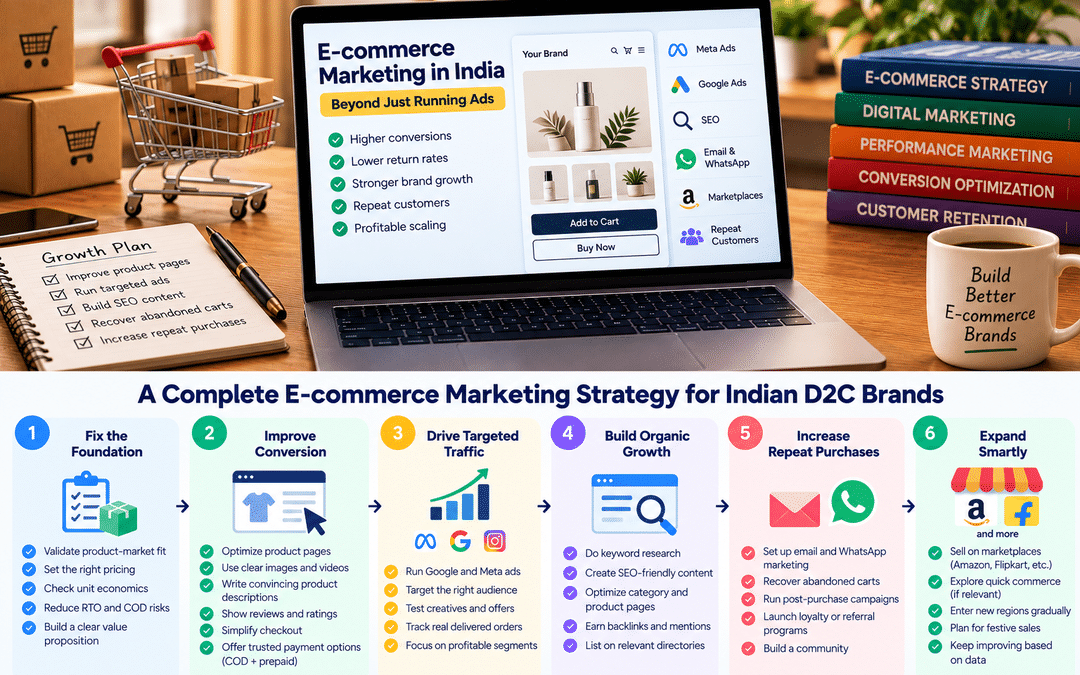
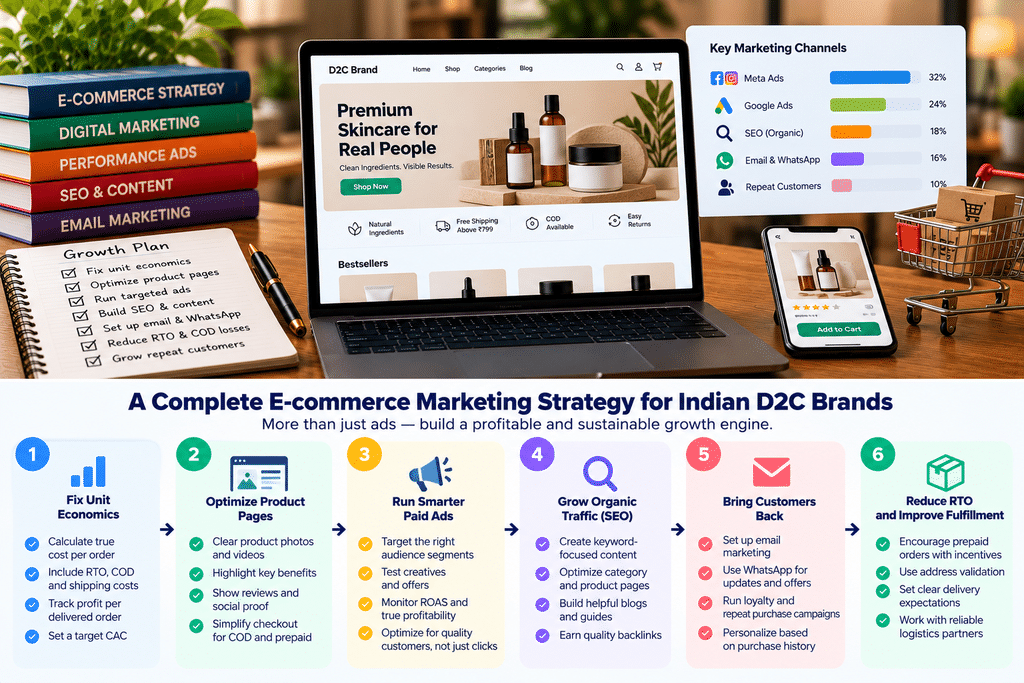
Brands that grow sustainably usually do several things alongside ads: fix unit economics, improve product page conversion, earn free traffic from search, bring customers back without paying again, choose sales channels deliberately, and cut losses from failed deliveries.
This guide covers each of those areas, with Indian examples. It’s written for D2C founders, e-commerce managers and marketers who already run ads and want growth that doesn’t depend entirely on them.
What makes Indian e-commerce different
Most e-commerce marketing advice is written for markets where nearly everyone pays by card, and almost every parcel is accepted. India works differently, and those differences shape what marketing can achieve.
Cash on delivery is still central.
Many Indian shoppers, especially first-time buyers and those outside the big metros, prefer to pay when the parcel arrives. Industry estimates of COD’s share of orders vary, but some fulfillment providers put it above half of all e-commerce orders. COD widens your market, but it brings a cost most ad dashboards don’t show.
Return to origin (RTO) eats margin.
RTO happens when an order can’t be delivered and comes back: the customer refuses it, isn’t available, or gave an incomplete address. You pay shipping both ways and earn nothing.
Figures vary by source and category, but 2026 industry reports put typical D2C RTO rates between 18% and 32%, and COD orders are much more likely to return than prepaid ones. One logistics provider estimates COD RTO at 25 to 30% against 2 to 3% for prepaid orders. Rates also tend to rise further from the metros.
For marketers, the implication is direct: an ad campaign that produces many COD orders in high-RTO areas can look profitable in Ads Manager and lose money in reality.
Growth is shifting to smaller cities.
According to Unicommerce’s FY2026 data, as reported by MediaBrief, Tier 2 and Tier 3 cities drove about two-thirds of new D2C orders. These customers can be very valuable, but they often need more trust before buying, which affects messaging, payment options, and delivery promises.
Marketplaces and quick commerce shape expectations
Amazon and Flipkart set expectations for price, delivery speed, and easy returns. Quick commerce apps have trained urban customers in categories like snacks and personal care to expect delivery in minutes. A D2C website competes with those experiences, whether or not the brand sells on those platforms.
Demand peaks around festivals and sales
Diwali, major marketplace sales, and regional festivals create sharp demand spikes. Industry reports note that festive periods bring more first-time buyers and more COD orders, and therefore higher RTO. Planning for the peak, and for what happens after it, matters more than in steadier markets.
Fix the unit economics before scaling ads.
Before spending more on ads, check whether each order actually makes money once delivered. Many brands discover that their “profitable” campaigns aren’t.
Why ROAS can mislead
Return on ad spend (ROAS) divides revenue from ads by ad cost. It ignores product costs, shipping, payment fees, and, crucially, orders that never get delivered.
Here’s an illustrative example for 100 orders from a campaign. All figures are hypothetical, and GST is ignored for simplicity:
| Item | Calculation | Amount |
| Orders placed | 100 | |
| Average order value | ₹800 | |
| Ad spend | 100 orders × ₹250 per order | ₹25,000 |
| ROAS shown in the ad dashboard | ₹80,000 ÷ ₹25,000 | 3.2 |
| Orders returned (20% RTO) | 20 | |
| Delivered orders | 80 | |
| Revenue from delivered orders | 80 × ₹800 | ₹64,000 |
| Product cost | 80 × ₹300 | −₹24,000 |
| Shipping, payment fees,s and packaging on delivered orders | 80 × ₹110 | −₹8,800 |
| Cost of returned orders (shipping both ways, packaging) | 20 × ₹160 | −₹3,200 |
| Ad spend | −₹25,000 | |
| Profit | ₹3,000, about ₹38 per delivered order |
A ROAS of 3.2 looks healthy. In reality, this campaign barely breaks even, and a slightly higher RTO rate or ad cost would turn it into a loss.
The numbers worth tracking instead
- Contribution margin per delivered order: revenue minus product, shipping, payment, and packaging costs, before marketing.
- Customer acquisition cost (CAC) per delivered first order, not per order placed.
- RTO rate by payment method, region, and campaign.
- Repeat purchase rate and customer lifetime value (LTV), which show a customer’s value over time, not just on the first order.
- Payback period: how long it takes for a customer’s profit to cover the cost of acquiring them.
If a first order loses money, the business depends on repeat purchases to make it worthwhile. That’s why retention, covered later, isn’t optional for most D2C brands.
Product pages and on-site conversion for Indian shoppers
Every conversion-rate improvement makes every rupee of marketing work harder, including free traffic. For many brands, it’s the cheapest growth available.
What Indian shoppers look for before buying
| Element | Why it matters |
| Delivery date by PIN code | Shoppers want to know when it will arrive at their address, not a generic “5 to 7 days” |
| Payment options shown early | UPI, cards and COD availability, plus any prepaid discount, reduce uncertainty |
| Clear return or exchange policy | Especially important for fashion, footwear and first-time buyers from a new brand |
| Reviews with photos | Real customers’ photos build more trust than studio images, particularly for new D2C brands |
| Size guides and fit help | Indian sizing varies between brands; vague size charts drive returns |
| Specific product information | Ingredients, materials, dimensions, shelf life, usage instructions, and any certifications that apply to the category |
| Price clarity | Show the final price, including taxes and delivery, without surprises at checkout |
| A quick way to ask questions | A WhatsApp chat button answers pre-purchase questions that would otherwise end in an abandoned cart |
Make the site work on everyday phones
Most shoppers browse on mid-range Android phones, often on mobile data. Test your product and checkout pages on such a phone outside office Wi-Fi. Heavy images, autoplay videos, and pop-ups that are fine on a laptop can make a page painfully slow.
Simplify checkout
- Keep the number of steps and form fields to a minimum
- Offer UPI prominently, alongside cards and COD
- Use address autofill and PIN code validation to reduce delivery failures
- Allow guest checkout, or a quick login with a mobile number
Test, don’t guess
Change one significant thing at a time, such as the delivery-date display or the position of reviews, and compare conversion rates over a few weeks. Small, steady improvements add up across every channel.
SEO and Google’s free product listings
Organic search takes longer to build than an ad campaign, but once pages rank, each new customer from search costs no extra ad spend. For many D2C brands, it’s the most underused channel.
List your products on Google for free.
Google Merchant Center is free to use, and India is one of the countries where products can appear in free listings. Once your product feed is approved, products can show across Google, including the Shopping tab, Search, Images, Lens, and YouTube, without paying per click.
A few practical points:
- Shopify, WooCommerce, and other platforms offer integrations that automatically sync your catalog to Merchant Center.
- Feed quality decides visibility. Clear titles, accurate prices, good images, correct availability, and specific product categories all matter.
- The same feed powers Shopping ads if you run them later, so there’s no extra work.
- Paid placements are expanding. In April 2026, sponsored tiles appeared in the Shopping tab’s free listing grid. Free visibility still exists, but expect more competition from ads.
Google’s guidance on AI search also points merchants to Merchant Center as the way to provide product information that can appear in AI responses. Accurate, detailed product data now matters for AI Mode as well as the Shopping tab.
Website SEO for e-commerce
| Page type | What to do |
| Category pages | Target commercial searches like “cotton kurtas for women” or “millet snacks”. Add a short, useful introduction and filters that help shoppers |
| Product pages | Write unique descriptions rather than copying the manufacturer’s text, add product structured data, and include real reviews |
| Buying guides | Answer pre-purchase questions: “how to choose a running shoe for flat feet”, “millets vs oats”. These attract earlier-stage shoppers and link to products |
| Out-of-stock products | Keep the page live where it has traffic, show restock dates and suggest alternatives, rather than deleting it |
Include the way Indians actually search: price-based terms like “under ₹999”, “price in India” and sizes or variants common in India. Our keyword research guide explains how to find them, and the SEO audit guide covers technical checks that often trip up e-commerce sites, such as thin filter pages and duplicate product URLs.
Retention: WhatsApp, email, loyalty, and repeat purchase
Acquiring a customer through ads is expensive. Bringing them back through your own channels is far cheaper. For D2C brands whose first order barely breaks even, repeat purchases are where profit lives.
Build a post-purchase journey.y
The weeks after the first order shape whether there’s a second. A simple sequence:
| When | Message | Channel |
| Order placed | Confirmation, with expected delivery date | WhatsApp or SMS |
| Shipped and out for delivery | Tracking updates | WhatsApp or SMS |
| A few days after delivery | How to use or care for the product; who to contact with problems | WhatsApp or email |
| One to two weeks later | Request a review, with a direct link | WhatsApp or email |
| When the product typically runs out | Replenishment reminder for consumables like snacks, skincare or supplements | WhatsApp or email |
| Occasionally | New launches, festive collections or offers, only to opted-in customers | WhatsApp or email |
Send replenishment reminders based on how long the product actually lasts. A 30-day face serum and a 200g snack pack need very different timing.
Choose channels deliberately
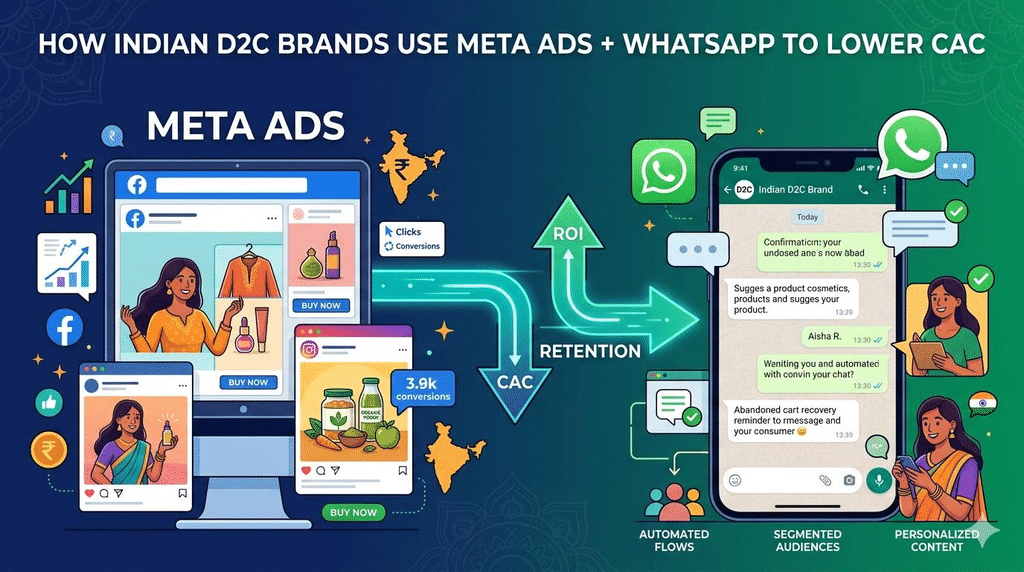
WhatsApp gets attention in India like few other channels, but marketing messages on the WhatsApp Business Platform cost money and require opt-in. Use it for high-value messages. Our WhatsApp marketing guide covers current pricing and rules.
Email costs far less per message and suits longer content: guides, recipes, styling ideas and newsletters. It’s worth building even if open rates are modest.
SMS is useful for transactional updates, though it’s less engaging for marketing.
Give customers reasons to return
- Loyalty points or tiered rewards for repeat customers
- Referral programs that reward both the referrer and the new customer
- Subscriptions for consumables, with a small discount and easy pausing
- Bundles that introduce customers to other products in your range
Collect consent properly
Ask for permission to send marketing messages at checkout, with a clear checkbox for WhatsApp and email. India’s Digital Personal Data Protection Act, 2023 sets consent requirements for using personal data, and Meta requires opt-in for WhatsApp marketing. Good consent practices also protect your sender reputation.
Marketplaces, quick commerce and your own website: choosing the mix
Indian D2C brands rarely sell through one channel. The question isn’t whether to use marketplaces or your own site, but what role each should play.
| Channel | Strengths | Trade-offs | Often best for |
| Your own website | Higher margin per sale, full customer data, control over brand and experience | You must bring every visitor yourself | Building a brand, retention, bundles and subscriptions |
| Marketplaces (Amazon, Flipkart and category platforms) | Huge existing demand, trusted payments and returns | Commissions and fees, intense price competition, limited access to customer data, ads needed for visibility | Discovery, reaching shoppers who search marketplaces first, volume |
| Quick commerce apps | Instant delivery for urban, impulse and repeat categories | Listing terms, in-app advertising and margin pressure; works mainly in large cities | Snacks, beverages, personal care and other everyday categories |
| Social commerce (Instagram, WhatsApp catalogs) | Close to where discovery happens; personal conversations | Harder to scale and track | Launches, small catalogs, high-consideration purchases |
| Offline retail and modern trade | Physical presence and trust | Distribution costs, slower payments | Brands with proven demand in specific regions |
Give each channel a clear job
A common pattern: marketplaces and quick commerce bring discovery and volume, while the website focuses on loyal customers, full-price sales, bundles and subscriptions. Insert-card offers, QR codes in packaging, and loyalty benefits can encourage marketplace customers to buy their next order directly, within each marketplace’s rules.
Watch out for channel conflict.
If the same product is cheaper on a marketplace than on your website, shoppers notice. Keep pricing consistent, or give direct customers a clear reason to buy from you, such as exclusive variants, bundles, or loyalty rewards.
Remember that marketplace ads are still ad.s
Visibility on marketplaces increasingly depends on sponsored listings. Moving from Meta ads to marketplace ads changes where the money goes, not the underlying dependence on paid acquisition. Track marketplace ad costs with the same discipline.
Content, community and creators
Brands that customers talk about need less advertising to be remembered. Content, community, and creators build that familiarity and produce better ad material.
Tell the story only you can tell.
Why the founder started the brand, where ingredients come from, how products are made, what the team got wrong and fixed: this is content no competitor can copy. Short videos showing the real process, the real team, and real customers often outperform polished campaigns, especially for newer brands that need to earn trust.
Make customers part of the content.
- Reviews and photos on product pages and social media
- Unboxing and usage videos from real customers, shared with permission
- Customer questions answered publicly as short videos or posts
This user-generated content builds trust, and it gives you a steady supply of authentic ad creative. That matters because Meta’s ad systems increasingly rely on varied creative to find the right audiences, as our Meta ads troubleshooting guide explains.
Work with creators thoughtfully.y
- Smaller creators often work better than celebrities for D2C brands. Their audiences are often more engaged and more specific, such as home cooks in Karnataka or runners in Bangalore.
- Regional-language creators can reach audiences that English content misses.
- Ongoing partnerships usually work better than one-off posts, because repeated mentions build familiarity.
- Give creators freedom to present the product in their own voice; scripted posts often feel like ads.
- Follow disclosure rules. ASCI, India’s advertising self-regulator, requires creators to label paid or sponsored content clearly.
- Track results with unique discount codes or links for each creator.
Build community where it fits.
For some categories, community is a genuine advantage: a running club for a sportswear brand, recipe groups for a food brand, skincare routines for a beauty brand. Pop-ups, events, and WhatsApp communities can turn customers into advocates. Community takes sustained effort, so start small and only where customers genuinely want to connect.
Reducing COD and RTO losses
RTO is often treated as an operations problem. Marketing causes much of it, and marketing can fix much of it.
Encourage prepaid payment, without forcing it.
Removing COD entirely usually costs sales, especially outside the metros. Instead, make prepaid more attractive:
- A small prepaid discount or cashback. One fulfillment provider suggests ₹30 to ₹50 incentives for prepaid orders.
- A post-order payment link on WhatsApp, letting COD customers switch to UPI before dispatch.
- A small COD fee, clearly shown, in categories where it doesn’t hurt conversion too much.
Confirm COD orders before shipping.
A quick WhatsApp message or call asking the customer to confirm a COD order catches many accidental, duplicate, and impulse orders before you pay for shipping. Orders that aren’t confirmed can be held or canceled.
Improve address quality
Incomplete addresses are a common cause of failed delivery. Validate PIN codes at checkout, ask for a landmark, and confirm addresses that look incomplete.
Use risk-based COD
Track RTO by PIN code, customer, and order pattern. Many brands turn off COD, or ask for partial prepayment, for areas or customers with repeated refusals, while keeping it open elsewhere.
Act fast on failed delivery attempts.
When a courier can’t deliver, there’s usually only a short window, often around 24 hours, to reschedule before the parcel heads back. An automated WhatsApp message asking the customer to choose a new time can rescue many of these orders.
Bring RTO into marketing decisions.
- Measure RTO by campaign, ad set, and region, not just across the store.
- Look at delivered orders, not placed orders, when judging campaigns.
- Be careful with impulse-driven offers such as “gift with COD”, which can attract orders people later refuse.
- Promise realistic delivery times. Customers who wait longer than expected are more likely to refuse a parcel.
Measuring what matters: the numbers beyond ROAS
Ad platforms each report their own results, and their numbers often overlap or overstate. A small set of business-level numbers gives a truer picture.
| Metric | What it tells you | How to calculate it |
| Contribution margin per delivered order | Whether each order makes money before marketing | Revenue minus product, shipping, payment, and packaging costs, per delivered order |
| Blended CAC | What you really pay to win a new customer, across all channels | Total marketing spend ÷ new customers whose first order was delivered |
| Marketing efficiency ratio (MER) | A reality check on platform-reported ROAS | Total revenue ÷ total marketing spend |
| RTO rate by segment | Where undelivered orders come from | Returned orders ÷ shipped orders, split by payment method, region and campaign |
| Repeat purchase rate | Whether customers come back | Customers with two or more orders ÷ all customers, over a set period |
| Customer lifetime value (LTV) | How much profit a customer brings over time | Average contribution per customer across all their orders |
| Payback period | How quickly you recover acquisition cost | Time until a customer’s cumulative contribution exceeds their CAC |
| Share of revenue from owned channels | How dependent you are on paid traffic | Revenue from organic search, direct, email, WhatsApp and referrals ÷ total revenue |
| Conversion rate and average order value | How well the site turns visits into sales | From your store platform or GA4 |
A simple weekly view
You don’t need a complex dashboard. A weekly spreadsheet with total revenue, total marketing spend, new and repeat customers, RTO rate, and contribution margin answers the most important questions.
Watch the trend in share of revenue from owned channels. If it rises over time, the business is becoming less dependent on ads, which is the goal of everything in this guide.
Set up purchase tracking in GA4 and link it to your store platform. Our GA4 for Beginners guide covers the basics, but remember that analytics tools also miss some sales. Your store’s own order data is the final source of truth.
Worked example: a D2C snack brand from Bangalore
This is a hypothetical example. All figures are illustrative.
The situation. A Bangalore brand sells millet-based snacks through its own website. It spends about ₹3 lakh a month on Meta ads, and Ads Manager reports a ROAS of around 2.8. Yet the business is losing money. About 60% of orders are COD, nearly 28% of shipped orders come back as RTO, and only around 12% of customers order again within three months.
What the brand changed over six months:
| Area | Change |
| Unit economics | Calculated contribution per delivered order and CAC per delivered first order for the first time, and stopped judging campaigns on ROAS alone |
| COD and RTO | Added a ₹40 prepaid discount, WhatsApp confirmation for COD orders, and partial prepayment for PIN codes with repeated refusals |
| Product pages | Showed delivery dates by PIN code, full nutrition information, and reviews with customer photos |
| Search | Listed products for free on Google through Merchant Center, and published buying guides such as healthy tiffin snacks for children |
| Retention | Sent replenishment reminders about three weeks after delivery, launched a monthly subscription with a small discount, and added a referral reward |
| Channels | Listed best-sellers on a quick commerce app in Bangalore for discovery, while keeping bundles and subscriptions exclusive to the website |
| Creators | Partnered with a handful of home cooks and fitness creators, including some creating in Kannada, on ongoing arrangements with tracking codes |
Six months later (illustrative):
| Metric | Before | After |
| COD share of orders | About 60% | About 40% |
| RTO rate | About 28% | About 16% |
| Repeat purchase rate within 90 days | About 12% | About 22% |
| Share of revenue from owned channels | About 18% | About 33% |
| Contribution after marketing | Negative | Positive |
Ad spend stayed roughly the same. The difference came from everything around the ads: fewer wasted shipments, better pages, free search visibility, and customers who came back on their own.
Real results vary widely by category, price, and execution. The point is the approach: treating ads as one part of the system, not the whole of it.
Frequently asked questions
What is the best marketing strategy for an e-commerce brand in India?
There’s no single strategy, but sustainable brands usually combine paid ads with strong product pages, SEO and free Google listings, retention through WhatsApp and email, a deliberate mix of website and marketplace sales, and active efforts to reduce COD and RTO losses.
Why are my e-commerce ads profitable on paper but not in reality?
Platform ROAS ignores product costs, shipping, payment fees,s and undelivered orders. Calculate contribution margin per delivered order and CAC per delivered first order to see whether campaigns actually make money.
What is RTO in e-commerce?
RTO, or return to origin, happens when an order can’t be delivered and goes back to the seller, usually because the customer refuses it, isn’t available, or gave an incomplete address. The seller typically pays shipping both ways.
Should I stop offering cash on delivery?
Usually not entirely, because COD helps reach many Indian customers. Instead, encourage prepaid payment with small incentives, confirm COD orders before dispatch, and limit COD for high-risk areas or customers.
Is it free to list products on Google Shopping in India?
Yes. India is one of the countries where products can appear in free listings through Google Merchant Center. Paid Shopping ads are a separate option.
Should a D2C brand sell on Amazon and Flipkart?
Often, yes, for discovery and volume. But marketplaces bring fees, price competition, and limited customer data. Many brands use marketplaces for reach and their own website for loyal customers and higher-margin sales.
How can I improve repeat purchases?
Build a post-purchase journey with usage tips, review requests,s and replenishment reminders timed to when the product runs out, and add loyalty rewards, referrals, or subscriptions where they fit.
Where can I learn e-commerce marketing hands-on?
Practical experience on real stores teaches the most. At Web Marketing Academy, we cover e-commerce marketing through hands-on digital marketing training, including Google Shopping, social media, and analytics, with work on live projects.
