
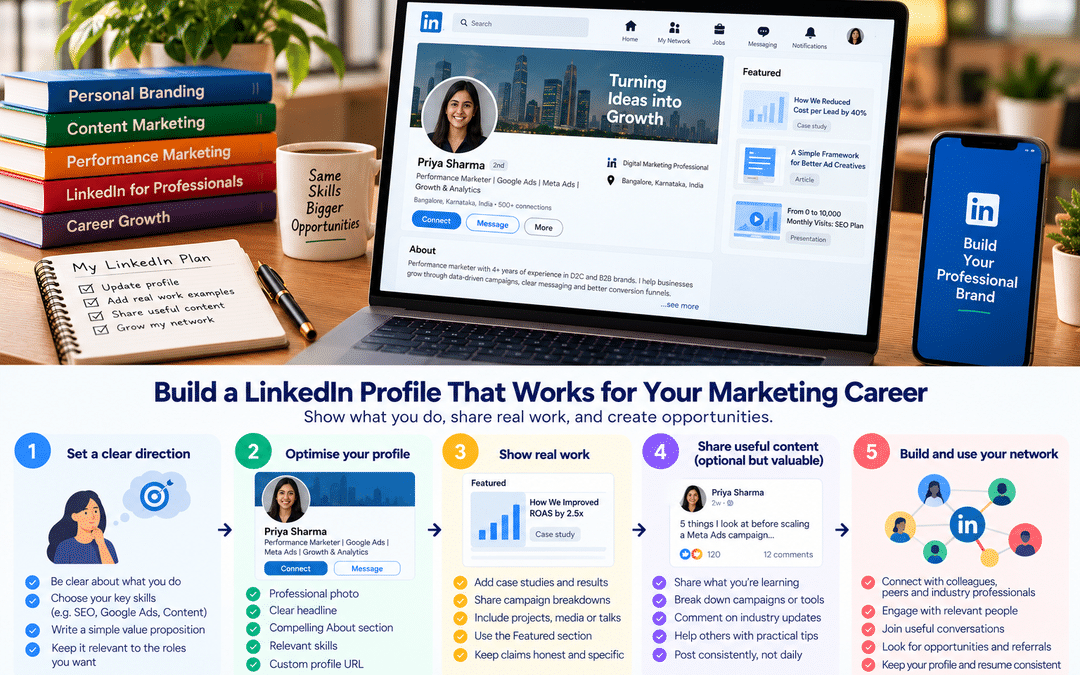
Picture a hiring manager at a Bangalore startup with 80 applications for a performance marketing role. Your resume makes the shortlist. Before calling you, she does what most recruiters do: she looks you up on LinkedIn.
She finds a profile with a two-year-old photo, a headline that says “Seeking opportunities,” no summary, and a job history copied from your resume. Another candidate, with a similar resume, has a clear headline, a summary of what she’s good at, a few posts breaking down campaigns she ran, and a recommendation from a former manager. Guess who gets the first call.
For most professions, LinkedIn is a useful extra. For marketers, it’s something more: a public sample of your work. You’re applying for a job that involves positioning, messaging, and building audiences. Your own profile is the first piece of marketing an employer sees from you.
This guide explains what personal branding actually means for marketers, how LinkedIn and your resume work together, how to build a profile section by section, what to post if you choose to, and how to approach it at different career stages. It’s written for freshers, working marketers, career switchers, and freelancers, and it doesn’t assume you want to become an influencer.
What personal branding means for a marketer, and what it doesn’t
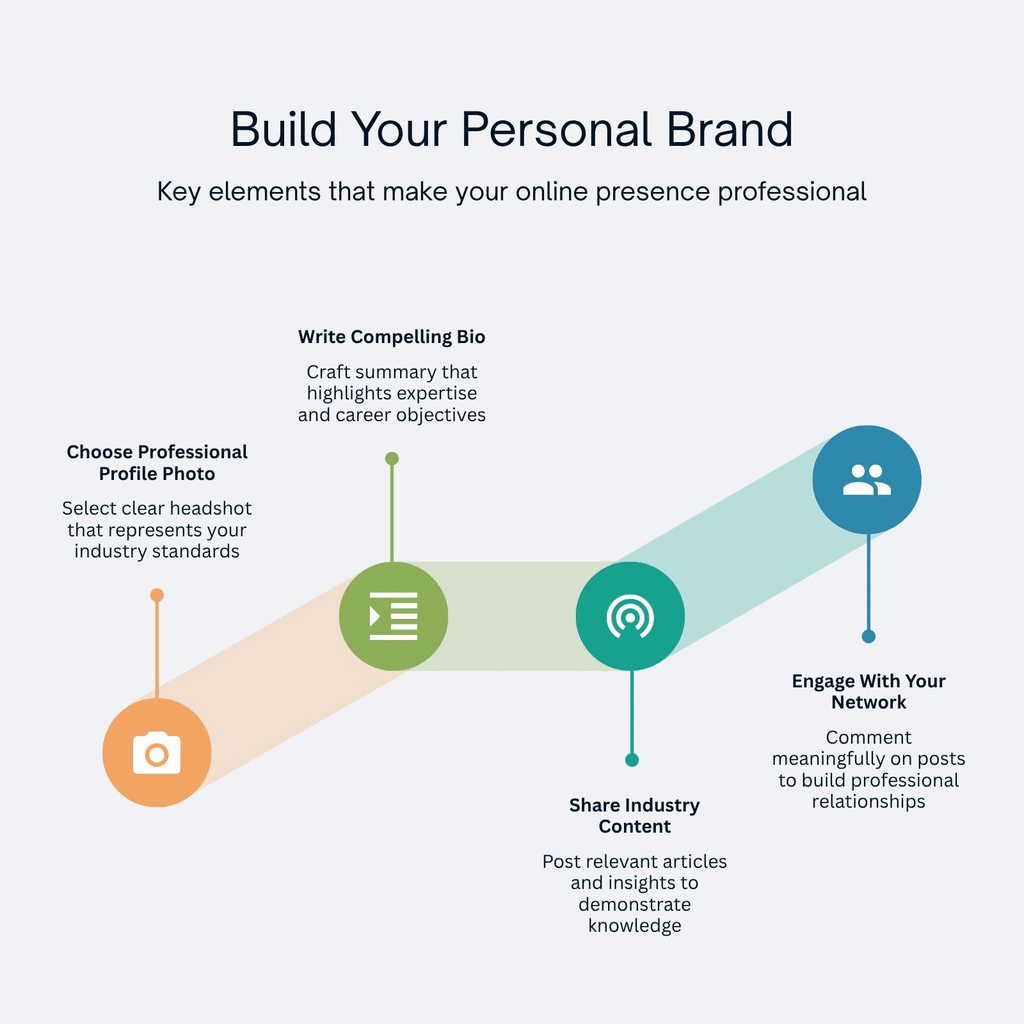
“Personal branding” often conjures images of daily motivational posts, carefully staged photos, and thousands of followers. That’s one version, and it isn’t what most marketers need.
For a working marketer, personal branding means this: when someone looks you up, they quickly understand what you’re good at and find evidence.
| Personal branding is | Personal branding isn’t |
| Being clear about what you do and who you help | Posting every day for the sake of it |
| Showing real work, results and thinking | Exaggerating results or inventing experience |
| A professional, consistent presence | A different persona from who you really are |
| Helping others with what you know | Constant self-promotion |
| Building relationships over time | Chasing follower counts |
Why it matters more for marketers
Your profile is a work sample. If you claim to understand positioning, audiences, and content, employers will notice whether your own profile reflects that.
Marketing changes fast. Posts and comments show that you follow developments in AI search, ad platforms, and analytics, which a resume can’t easily prove.
Opportunities often come through people. Referrals, freelance projects, and job offers frequently come from someone who has seen your work or remembers a useful comment you made. Visibility creates chances that formal applications don’t.
It compounds. A clear profile and a modest record of thoughtful posts keep working for you long after you wrote them.
Resume vs LinkedIn: what each one does
A resume and a LinkedIn profile aren’t competitors. They serve different purposes at different times.
| Resume | LinkedIn profile | |
| When it’s seen | When you apply | Before you apply, after you apply, and when you’re not applying at all |
| Who controls the context | You choose who receives it | Anyone can find it: recruiters, clients, colleagues, the hiring manager’s team |
| Length and tone | One or two pages, formal and concise | More room for personality, context and detail |
| Tailoring | Rewritten for each role | One version for everyone, so it needs a clear overall direction |
| Proof | Claims and numbers | Claims plus evidence: posts, case studies, recommendations, media |
| Discoverability | Not searchable | Searchable by recruiters looking for skills and locations |
They must agree with each other
The biggest problem isn’t a weak profile; it’s an inconsistent one. If your resume says “Performance Marketing Executive, managed ₹5 lakh monthly budgets” and your LinkedIn says “Digital Marketing Enthusiast”, a recruiter notices. Job titles, dates, and key achievements should match. LinkedIn can add context and examples, but it shouldn’t contradict your resume.
Why LinkedIn matters as much as the resume
The resume gets you considered. LinkedIn often decides how you’re perceived. Recruiters may find you through search before you ever apply, and hiring managers commonly check profiles before interviews. For marketers in particular, the profile is where your communication skills are on public display.
Building a LinkedIn profile that works
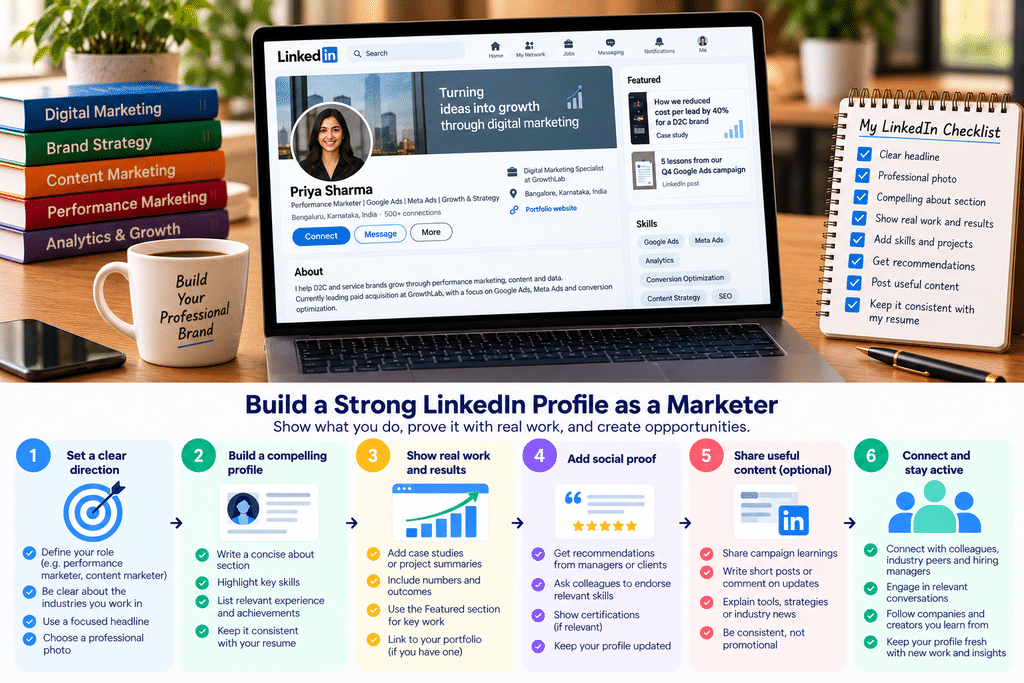
Most of your profile’s impact comes from the top section and a few key areas. Get these right before thinking about posting.
The headline: say what you do, not that you’re looking
The headline appears everywhere: search results, comments, connection requests. “Seeking opportunities” or “Digital Marketing Enthusiast” tells people nothing about what you can do.
A simple formula: role or specialism + what you help with + proof or context.
| Weak headline | Stronger headline |
| Digital Marketing Enthusiast | SEO Executive · Local SEO & Google Business Profile for clinics and service businesses |
| Looking for opportunities in marketing | Performance Marketer in training · Google & Meta Ads · Ran live campaigns for two local businesses |
| Marketing Manager at XYZ | B2B Marketing Manager · Demand generation for SaaS · LinkedIn, content and webinars |
| Sales Executive | B2B sales professional moving into performance marketing · Google Ads & CRM |
The About section: the first lines do most of the work
LinkedIn moved the About section back to the top of profiles in 2024, so it’s one of the first things visitors read. Only the opening lines show before someone clicks “see more,” so lead with what matters.
A simple structure:
- What you do and for whom, in one or two sentences
- What you’re good at, with one or two specific results or examples
- How you work, or what you care about, briefly
- What you’re looking for, if relevant, and how to reach you
Write in the first person and in plain language. Avoid lists of buzzwords like “results-driven, passionate, dynamic”.
The Featured section: your portfolio
The Featured section, available on every profile since LinkedIn retired Creator Mode, lets you pin posts, links, and files near the top of your profile. For marketers, it’s the most underused part of LinkedIn. Pin:
- A case study, as a PDF or a post, showing a project with results
- Your best post explaining something you know well
- A link to your portfolio, blog,g or a campaign you worked on
- A certification that matters for your target roles
Experience: results, not responsibilities
The same principle as your resume applies. “Managed social media accounts” says little. “Grew Instagram inquiries for a Koramangala salon by planning a reels-first content calendar and tracking WhatsApp inquiries” says what you did and why it mattered. Keep titles and dates consistent with your resume.
Skills, recommendations and the rest
- Skills. Add the skills your target roles ask for, and attach them to the relevant experience or project. LinkedIn discontinued its skill assessment badges, so the context around a skill matters more than a quiz result.
- Recommendations. Two or three specific recommendations from managers, clients, or trainers carry far more weight than dozens of skill endorsements. Ask people who’ve seen your work, and suggest what they might mention.
- Photo and banner. A clear, recent, friendly photo; a banner that reinforces what you do, rather than a stock image.
- Custom URL. Change your profile link to something clean, such as /in/yourname.
- Open to Work. If you’re job-hunting while employed, LinkedIn lets you signal this only to recruiters, rather than with the public green frame. Choose based on your situation.

What to post, and how often
You don’t have to post to benefit from a strong profile. But a modest, consistent record of useful posts makes your expertise visible in a way a profile alone can’t.
Five kinds of posts that work for marketers
| Post type | Example |
| Work breakdowns | “We cut cost per lead for a local clinic’s Google Ads by fixing three settings. Here’s what they were.” (Share only with permission, and anonymize client details.) |
| Explaining something clearly | “What Search Console’s new generative AI report actually counts, in plain English” |
| Lessons from mistakes | “I ran my first Meta campaign on the Traffic objective. Here’s what 2,000 clicks and zero leads taught me.” |
| Your take on industry changes | “Google says GEO is still SEO. Here’s what that means for small businesses.” Add your view, not just the news |
| Useful resources | A checklist, template, or prompt you actually use, shared freely |
For freshers and career switchers, a sixth type works well: learning in public. Share what you built this week, what confused you, and what finally made sense. It shows initiative and progress, which is exactly what employers want to see in a junior hire.
A simple structure for a post
- An opening line that states the point or the problem plainly
- Context: what happened or what you were trying to do
- The insight: what you learned, did,d or recommend
- A takeaway someone else can use
Keep it readable on a phone: short paragraphs and no wall of hashtags.
How often?
Once a week is enough for most people, and far more sustainable than daily posting. Consistency over months matters more than a burst of activity. If weekly is too much, post twice a month and comment thoughtfully in between.
What to avoid
- Engagement bait, such as “Comment YES if you agree”
- Generic AI-written posts. Readers recognize them quickly, and they undermine the expertise you’re trying to show. Use AI to help structure your thinking, then write in your own voice with your own examples.
- Confidential client or employer information, including screenshots with names, budgets, or private data
- Complaining about employers or clients. Future employers read these too
Visibility without becoming an influencer
Many marketers don’t want to post often, and that’s fine. You can build a strong professional presence mainly through comments, connections, and conversations.
Comment thoughtfully
A useful comment on a relevant post can be seen by many of the author’s followers. “Great post!” adds nothing. A comment that adds an example, a question, or a respectful counterpoint gets noticed.
For example, under a post about Meta ads costs, a comment like: “We saw something similar with a local client. Switching from Traffic to the Leads objective cut cheap clicks but doubled real inquiries. Curious whether you’ve seen the same.”
Ten thoughtful comments a week, on posts by people in your field, can build more visibility than an occasional post.
Connect deliberately
Connect with people you’d like to learn from or work with: marketers at companies you admire, recruiters for marketing roles, alums from your college or course, and people you meet at events. Add a short personal note explaining why you’d like to connect. A generic request with no note is easy to ignore.
Message to learn, not to ask for jobs.
A message asking “Do you have any openings?” rarely works. A message asking for a short conversation about someone’s work often does:
“Hi Ananya, I read your post on running B2B webinars. I’m moving from sales into B2B marketing and would value 15 minutes to hear how you got started. Happy to work around your schedule.”
These conversations often lead to advice, referrals,s and, eventually, opportunities.
Show up offline too
Bangalore has an active marketing and startup community: meetups, workshops, conferences, and alumni events. Connecting with people you meet in person on LinkedIn afterward, with a note referring to your conversation, turns a brief meeting into a lasting connection.
Personal branding at different career stages
What your profile needs to do changes with where you are in your career.
| Stage | Main goal | What to emphasize | Good content to share |
| Student or fresher | Show you can do the work, despite little experience | Projects, case studies, certifications, eagerness to learn | Learning in public, project breakdowns, simple explainers |
| Early-career marketer (1 to 3 years) | Build a reputation in a specialism | Results from your role, a clear focus area | Work breakdowns (with permission), lessons learned, tool tips |
| Mid-career or manager | Be known for judgment and leadership | Strategy, team results, industry perspective | Your view on industry changes, hiring and team lessons, frameworks |
| Career switcher | Connect your past to your new direction | Transferable skills, new projects, the reason for the switch | Your switching journey, how your old field informs marketing |
| Freelancer or agency owner | Win clients and trust | Services, client results, testimonials | Client case studies (with permission), practical advice for your target clients |
For freshers: projects are your experience
Without job titles to show, your Featured section and Projects carry the weight. A clear case study of a live project, such as optimizing a local business’s Google Business Profile or running a small ad campaign, is more convincing than a list of courses. Our interview question guide shows how to frame projects using Context, Action, Result, and Learning.
For career switchers: tell the bridge story.
Your headline and About section should connect where you’ve been with where you’re going. “Eight years in B2B sales, now focused on performance marketing” is a strength, not something to hide. Our guide to switching to digital marketing at 30+ covers this in more detail.
For freelancers: make it easy to hire yyou u
State clearly who you work with and what you deliver, show results and testimonials in Featured, and make contact details easy to find. Prospective clients are deciding whether to trust you with their money.
A 30-day plan
You can build a solid foundation in a month, spending around 20 to 30 minutes a day.
| Week | Focus | Tasks |
| Week 1 | Profile foundations | Update photo and banner; rewrite headline; write the About section; customize your profile URL; make sure titles and dates match your resume |
| Week 2 | Proof | Rewrite experience entries with results; add skills to relevant roles and projects; add one or two items to Featured, such as a case study; ask two people for specific recommendations |
| Week 3 | Network | Connect with 20 to 30 relevant people, each with a short personal note; leave thoughtful comments on posts in your field most days |
| Week 4 | First posts | Publish two posts using the structure above, such as a project breakdown and an explainer; reply to every comment; check post analytics to see what resonated |
After the first month, keep a lighter routine: one post a week or every other week, a few thoughtful comments most days, and a profile review every few months.
Worked example: a profile before and after
This is a hypothetical example.
Sneha recently completed a digital marketing course in Bangalore after a B.Com degree. She worked on a live project optimizing SEO and the Google Business Profile for a dental clinic, and ran a small Google Ads test. She’s applying for SEO executive roles.
| Section | Before | After |
| Headline | “Digital Marketing Enthusiast | Looking for opportunities” | “SEO Executive (fresher) · Local SEO & Google Business Profile · Live project for a Bangalore dental clinic” |
| About | Empty | Four short paragraphs: what she does, the clinic project with results, the tools she uses hands-on, and the roles she’s looking for |
| Featured | Empty | A two-page case study PDF on the clinic project, her Google Analytics certificate and her best post |
| Experience | Only an old part-time retail job | Added the live project, with three results-focused bullets; reframed the retail job around customer understanding |
| Skills | 40 random skills | Around 15 skills relevant to SEO roles, attached to the project |
| Recommendations | None | One from her course trainer, specific about her audit work |
| Activity | Only reshared posts | Two of her own posts: a breakdown of the clinic project, and an explainer on what makes a Business Profile rank locally |
What changed. Before, a recruiter searching for “local SEO” in Bangalore wouldn’t have found her, and anyone checking her profile would have seen nothing beyond her resume. After, her profile explains her focus in one line, shows real work within seconds, and backs her resume with evidence. In interviews, hiring managers can refer to her case study instead of asking generic questions.
None of this required daily posting or a large following. It took about a month of focused effort.
Common mistakes
A headline that asks instead of offers. “Looking for opportunities” describes your situation, not your value. Lead with what you do.
Copying the resume word for word. LinkedIn is a chance to add context, examples, and personality. Keep facts consistent, but use the space.
Inconsistent facts. Different titles, dates,s or claims on your resume and LinkedIn raise doubts quickly.
Exaggerating. Inflated results or titles are easy to spot, especially in marketing, where people know what realistic numbers look like. Small, honest results are more credible.
Buzzword-heavy summaries. “Passionate, results-driven, dynamic digital marketing professional” could describe anyone. Specific examples describe you.
An empty Featured section. For marketers, it’s the easiest place to show real work. Use it.
Posting generic AI content. It’s quickly recognized and works against the expertise you want to show.
Sharing confidential information. Client names, budgets, and private dashboards shouldn’t appear in posts without permission. Anonymize details.
Disappearing between job searches. A profile that’s updated only when you need a job looks like it. A light, ongoing presence works better than a sudden burst of activity.
Measuring success by likes. The goal is opportunities: conversations, referrals, interviews, and clients. A post with modest engagement that reaches the right person matters more than a viral one.
Frequently asked questions
Why is personal branding important for marketers?
Because your own profile is a public sample of your marketing skills. It shows how you position yourself, communicate,e and present evidence, and it makes it easier for recruiters, clients, and colleagues to find you and understand what you’re good at.
Do I need to post on LinkedIn regularly to benefit?
No. A clear, complete profile with real work in the Featured section already helps a great deal. Thoughtful comments and deliberate networking can add visibility without frequent posting. Posting weekly or every other week adds more, but it isn’t essential.
What should a fresher write in their LinkedIn headline?
State the role you’re targeting, your focus areas, and one piece of evidence, such as a live project. For example: “SEO Executive (fresher) · Local SEO & Google Business Profile · Live project for a Bangalore clinic”.
What should I put in the LinkedIn Featured section?
Your strongest evidence: a project case study, your best post, a link to your portfolio or blog, and certifications relevant to the roles you want.
Should my LinkedIn profile match my resume?
The facts should match exactly: titles, dates, and key achievements. LinkedIn can add more context, examples,s and personality, but it shouldn’t contradict your resume.
Can I use AI to write LinkedIn posts?
You can use AI to help structure ideas or edit drafts, but the experience, examples, and opinions should be yours. Generic AI-written posts are easy to spot and weaken the impression you want to create.
How long does it take to build a personal brand on LinkedIn?
A strong profile can be set up within a few weeks. A recognizable reputation in your niche usually takes months of consistent, useful activity.
Where can I get help building a portfolio worth showcasing?
Real projects make the strongest LinkedIn content. At Web Marketing Academy, learners work on live projects and finish with a case study they can feature on their profile, plus interview prep.
