
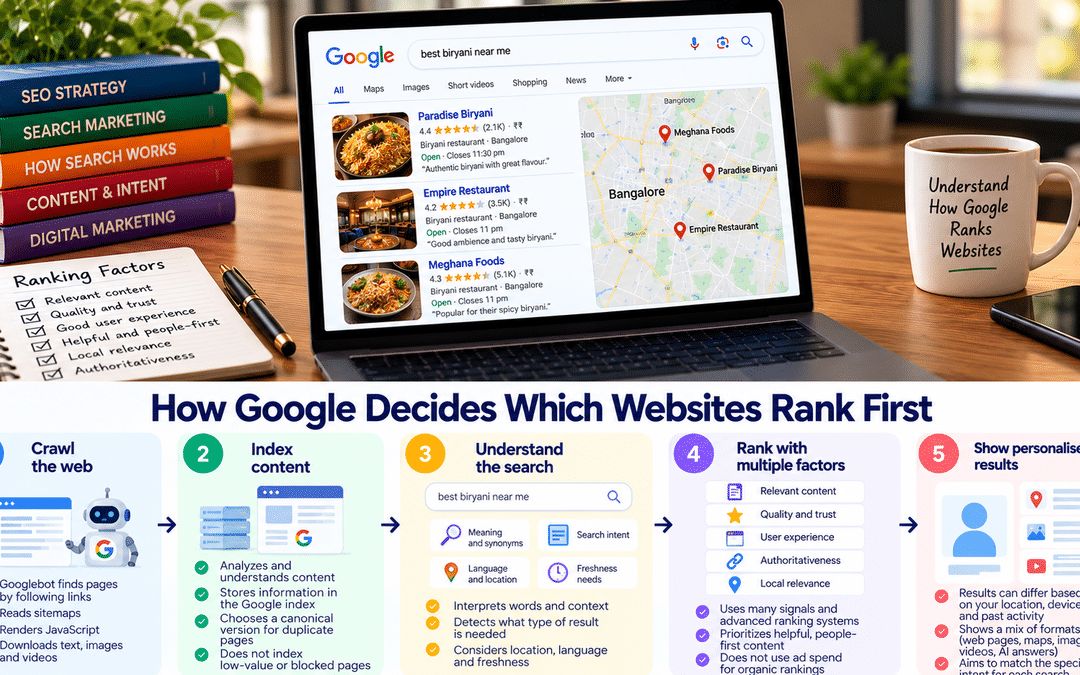
Type “best biryani near me” into Google in Bangalore and, in well under a second, it picks a handful of results from an index of a vast number of pages. One appears first. Business owners pay agencies, and agencies argue on forums, over why that one.
There’s a lot of mythology around the answer. Some people believe Google ranks whoever spends the most on ads. Others think there’s a secret list of exactly 200 factors, or that a site needs a particular word count, or that domain age decides everything.
The reality is both simpler and more complicated. Google doesn’t publish its exact formula, and no outsider knows it. But Google has explained a great deal about how the process works, which signals matter and which popular beliefs are wrong. Combined with court testimony and years of SEO industry observation, we can give a clear, honest picture.
This guide explains how Google goes from a search to a ranked list: how it finds and stores pages, how it understands what someone is looking for, the main factors it weighs, its named ranking systems, why results differ between people, and how AI Overviews choose their sources. It’s written for beginners, business owners, and anyone who wants to understand SEO from first principles.
Before ranking: crawling and indexing
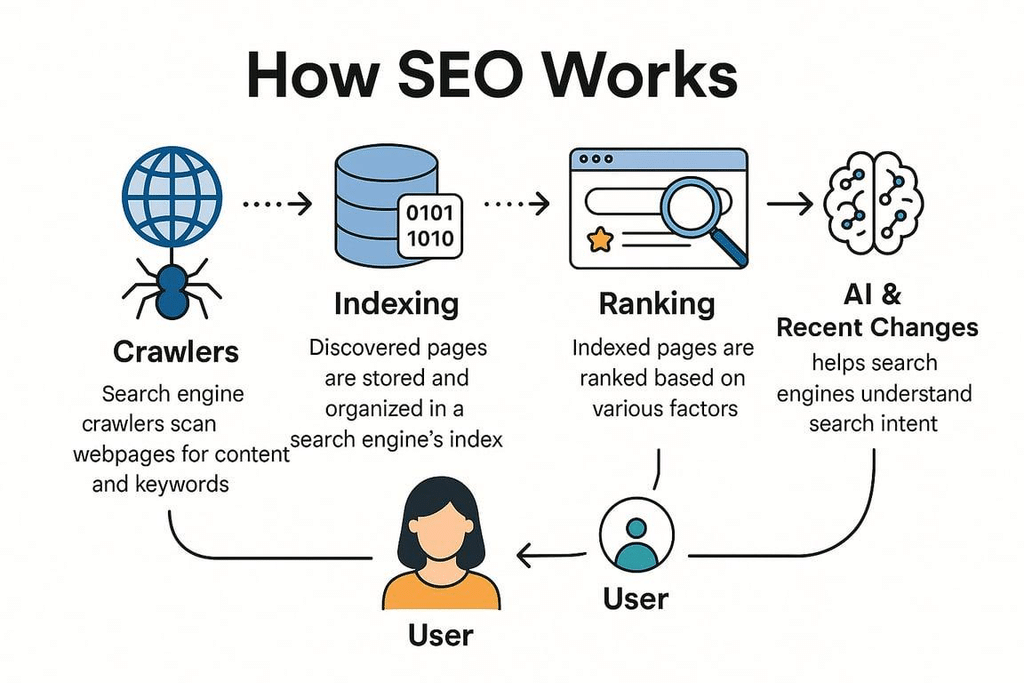
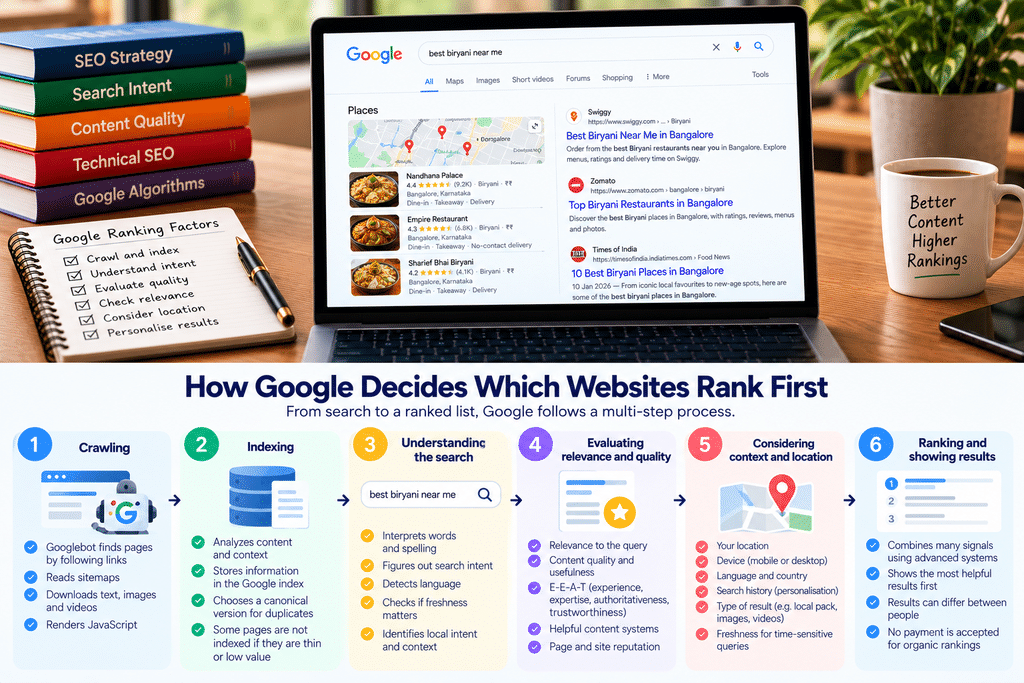
Ranking is the last step of a longer process. According to Google’s in-depth guide to how Search works, Google Search works in three stages, and not every page makes it through each one:
- Crawling. Automated programs called crawlers, mainly Googlebot, find pages and download their text, images, and videos. They discover pages by following links and reading sitemaps. Google also renders pages, running their JavaScript much like a browser, to see the content properly.
- Indexing. Google analyzes the content and stores information about it in the Google index, a massive database. If several pages are near-duplicates, Google chooses one as the canonical, the version that may be shown in results.
- Serving results. When someone searches, Google finds matching pages in the index and ranks them.
Why this matters for rankings
A page that isn’t crawled or indexed can’t rank at all, however good it is. Common reasons a page gets stuck:
- It’s blocked by robots.txt or marked noindex
- No other page links to it, so Google never finds it
- It’s a near-duplicate of another page, so a different version is chosen as canonical
- Google crawled it but judged it not worth indexing, which often happens with thin or low-value pages
- Server errors or very slow responses interrupted crawling
Google also states plainly that it doesn’t accept payment for crawling, indexing, or ranking. Running Google Ads doesn’t improve organic rankings.
You can check whether your pages are indexed in Google Search Console’s Pages report and URL Inspection tool. Our SEO audit guide explains how.
Understanding the search: meaning, intent and context
Before Google can rank anything, it has to work out what the person actually wants. Google’s own How Search Works pages describe this as establishing the intent behind the query.
That involves several things at once:
- Interpreting words and spelling. Google corrects typos and recognizes synonyms, so “cheep flights to goa” still finds cheap flights to Goa.
- Spotting the type of result wanted. Google notes that words like “cooking” or “pictures” signal that recipes or images may suit the search best.
- Recognizing the language. Google treats a search in Hindi or Kannada differently from one in English.
- Judging whether freshness matters. “IPL score” needs results from minutes ago; “what is photosynthesis” doesn’t.
- Detecting local intent. “Dentist near me” or “dentist Jayanagar” calls for nearby businesses and a map, not a national article.
Same words, different intent
The same query can mean different things, and Google often shows a mix of results to cover the likely meanings:
| Search | Possible intents | What Google might show |
| “digital marketing course” | Compare institutes, find one nearby, see fees, learn online | Course pages, local listings, comparison articles |
| “apple” | The fruit, the company, the share price | Mostly the company, perhaps a knowledge panel |
| “jaguar speed” | The animal or the car | The animal’s top speed, with some car results |
This is why matching intent matters so much for anyone hoping to rank. A page can be excellent and still never rank if it answers a different question from the one searchers are asking.

The main factors Google says it weighs
Google doesn’t publish a list of ranking factors with weights. It does describe the broad areas its systems consider. According to its ranking results page, Search algorithms consider many factors and signals, including query terms, page relevance and usability, source expertise, and the searcher’s location and settings.
Google groups these into five areas:
| Factor | What Google looks for | What it means for your site |
| Meaning of the query | What the searcher actually wants | Target the real intent behind searches, not just the words |
| Relevance of content | Whether the page contains information related to what was searched | Cover the topic clearly and specifically, in the words your audience uses |
| Quality of content | Signals of expertise, authoritativeness and trustworthiness | Show who’s behind the content, offer original insight, and earn mentions and links from credible sites |
| Usability | Whether the page is accessible and easy to use, including on mobile | Fast, mobile-friendly pages that work without frustrating pop-ups |
| Context and settings | Location, language, past search history and settings | Local businesses must show clearly where they are and whom they serve |
The weighting changes with each search
Google explains that the weight given to each factor varies with the nature of the query. For example: freshness matters more for current news than for dictionary definitions.
That’s why there’s no universal recipe. For a local service search, proximity and the Business Profile weigh heavily. For a medical question, expertise and trust are critical. For a breaking news story, freshness dominates.
Usability is a tie-breaker more than a trump card.
Google’s wording on usability is careful: when all things are relatively equal, content that people find more accessible may perform better. A fast page with weak content won’t beat a slower page that answers the question far better. But between two similarly useful pages, the easier one to use has an edge.
Ads don’t buy organic ranking.s
Google states that organic results are based on the query and aren’t influenced by whether a business buys ads. Paid ads appear in separately labeled slots.
Google’s named ranking systems
There isn’t one “Google algorithm”. Google uses many automated systems that each look at different signals and work together. Its guide to Google Search ranking systems describes the more notable ones.
| Area | System | What it does, in plain English |
| Understanding language | BERT | Understands how combinations of words change meaning and intent |
| Neural matching | Matches concepts in a search with concepts on a page, even when the words differ | |
| RankBrain | Understands how words relate to concepts, so pages can rank without containing every exact word searched | |
| Passage ranking | Identifies individual sections of a page that answer a query | |
| Quality and trust | Reviews system | Rewards reviews with insightful analysis and original research, by people who know the topic well. |
| Original content systems | Help show original content, including original reporting, ahead of pages that merely cite it. | |
| Reliable information systems | Prioritize reliable sources and show advisories when high-quality information is lacking | |
| Links | Link analysis systems and PageRank | Use how pages link to each other to understand what pages are about and which may be most helpful. PageRank, used since Google launched, remains part of the core systems |
| Timeliness | Freshness systems | Show more recent content where freshness matters, such as reviews of a newly released film |
| Results variety | Site diversity system | Generally avoids showing more than two results from the same site in the top results. |
| Deduplication systems | Avoid showing near-identical pages repeatedly | |
| Experience | Page experience system | Considers aspects of how people experience a page, such as loading speed and mobile usability |
| Protection | Spam detection systems, including SpamBrain | Detect content and behavior that violate Google’s spam policies |
| Removal-based demotion | Demote sites with many valid removal requests, such as copyright or personal information removals |
Google lists some older names you may still hear, such as Panda, Penguin, and Hummingbird, as retired or absorbed into other systems. Google launched its helpful content system in 2022, folded it into its core ranking systems in 2024, and now emphasizes people-first content throughout.
What this tells you
Notice how much of this list is about understanding meaning and judging quality. Very little is about mechanical details like keyword density. That’s the clearest signal of what matters: say something genuinely useful, clearly, in a way that matches what people are looking for.
Links, clicks, freshness and page experience, plus common myths
Links still matter, but quality beats quantity
Links from other sites have been part of Google’s ranking since its first version, through PageRank and related link analysis systems. A link works roughly like a recommendation. But not all recommendations are equal: a link from a respected Indian news site or industry body means far more than dozens from unrelated directories. Buying links or exchanging them in schemes violates Google’s spam policies.
Clicks and user behavior: what’s on the record
For years, SEO professionals debated whether Google uses clicks for ranking. More became public during the US government’s antitrust case against Google. In testimony in October 2023, Google’s Pandu Nayak described a system called Navboost, dating from around 2005, that uses historical click data to help narrow down large sets of results. He described it as one important signal, though not the only one. A large set of internal Google documentation that leaked in 2024 also referred to Navboost.
What this means in practice: pages that searchers choose and find useful tend to do better over time. It doesn’t mean you can manipulate rankings with fake clicks; Google’s spam systems are built to detect that. Write titles that accurately promise what the page delivers, and make sure the page actually delivers it.
Freshness matters for some searches, not all.
News, sports scores, prices, new product launches,s and anything time-sensitive benefit from fresh content. A guide to the basics of SEO doesn’t need updating every week, though it should stay accurate. Changing the date on a page without improving it doesn’t help.
Page experience: necessary, not sufficient
Google’s page experience system considers aspects such as speed, mobile usability, and security. Google also crawls and indexes most sites using its smartphone crawler, so the mobile version of your site is the one that counts.
Myths worth retiring
| Myth | What’s actually true |
| “Google uses exactly 200 ranking factors” | Google has never published a fixed list. Nayak’s testimony referred to the number of signals as maybe over a hundred, and their weights vary by query |
| “Running Google Ads improves organic rankings” | Google says organic results aren’t influenced by ad spending |
| “Longer content always ranks better” | Google has said there’s no ideal page length. Depth matters only if it helps the reader |
| “You need to repeat the keyword many times” | Google’s language systems understand synonyms and concepts; stuffing keywords can hurt |
| “Older domains always rank higher” | Domain age isn’t a shortcut; many new sites outrank old ones with better content |
| “An exact-match domain guarantees rankings” | Words in a domain are one of many relevance signals, and Google has a system to stop low-quality sites ranking just because of their domain name |
| “The meta keywords tag helps” | Google doesn’t use it for ranking |
| “More social media shares mean higher rankings” | Shares can bring visibility and links, but Google hasn’t confirmed them as a direct ranking factor |
Why results differ for different people
Two people searching the same words can see different results. That’s why “we’re ranking first” can be true on one person’s phone and false on another’s.
Location. For local searches, where you’re searching from changes everything. Someone searching “physiotherapy clinic” in Indiranagar and someone in Electronic City will see different businesses, sometimes completely different lists.
Language. Searching in Hindi, Kannada, or Tamil, or with a different language setting, changes which pages appear.
Device. Mobile and desktop results can differ in layout and sometimes in the results themselves.
Search history and settings. Google uses some personal context to tailor results. Its How Search Works pages explain that the “About this result” feature shows whether search history or other personal data influenced a result, and offers controls to turn personalization off.
Time. Rankings move constantly as Google updates its systems, competitors change their pages, and fresh content appears.
Testing. Google runs ongoing experiments so that some people may see a different layout or feature for a while.
What this means for checking your rankings
Searching for your own business from your office or phone gives a biased picture: you’re nearby, you may have visited your own site often, and your history influences results. Better ways to check:
- Use the average position and query data in Google Search Console, which reflect many real searches
- Search in a private window, signed out
- For local businesses, use local rank-tracking tools that check results from several locations
None of these is perfect, but together they’re far more reliable than a single search.
How AI Overviews and AI Mode choose sources
For many searches, the first thing people see is now an AI Overview, not a list of links. It’s natural to wonder whether that works on completely different rules.
Google’s guide to optimizing for generative AI search, published in 2026, says no: it describes optimizing for these features as still SEO. Two mechanisms explain why:
- Grounding in the Search index. The AI doesn’t answer from memory alone. Google’s ranking systems first retrieve relevant pages from the index, and the AI writes its answer from them, linking to sources. Pages that wouldn’t rank well in normal Search are unlikely to be used.
- Query fan-out. The AI runs several related searches behind the scenes to cover a question from different angles. Pages that rank for those related questions can feed into one answer.
Google’s guide adds a few specific points:
- To appear in AI features, a page must be indexed and eligible to show with a snippet in regular Search.
- Original, non-commodity content, offering first-hand experience or expert insight rather than repeating what’s widely available, gives Google a reason to use your page.
- Special files like llms.txt and tactics like “chunking” content aren’t needed for Google.
You can see how often your pages appear in AI Overviews and AI Mode in Search Console’s generative AI performance report.
For a deeper look, read our guides to GEO vs AEO vs SEO and Search Console’s generative AI report.
Worked example: why a small business can outrank a big brand
This is a hypothetical example, showing how the factors combine.
Someone standing near Gandhi Bazaar searches “best filter coffee near Basavanagudi”. Two businesses are nearby: a small, family-run café that has served filter coffee for 30 years, and an outlet of a large national coffee chain. The chain has a far bigger website, a much larger advertising budget, and thousands of links to its homepage.
| Factor | Family café | National chain outlet |
| Meaning of the query | Local intent, specific drink | Same query, same intent |
| Relevance | Its Business Profile, menu, and website mention filter coffee prominently, and many reviews talk about it | The outlet’s page is a generic store-locator entry; the menu focuses on espresso drinks |
| Quality and prominence | Hundreds of detailed reviews mentioning filter coffee; featured in local food blogs | Strong brand, but relatively few reviews for this specific outlet |
| Usability | A simple mobile page with hours, menu,u and directions | A large site that’s slower on mobile |
| Context | A couple of minutes’ walk from the searcher | Somewhat farther away |
For this search, the café is likely to appear first in the local results. The chain’s size doesn’t help much because the factors that matter for this query, local relevance, specific reviews, and proximity, favor the café.
Change the search to “coffee franchise opportunities India” and the picture flips. Now the chain’s official information, authority, and links matter most, and the café doesn’t compete at all.
The lesson: Google doesn’t rank websites in general; it ranks pages for specific searches. Small businesses win by being the best answer for the searches that matter to them, not by trying to beat big brands everywhere.
What this means for your website: practical priorities
Understanding how Google ranks pages leads to a fairly clear set of priorities, roughly in this order.
- Make sure Google can find and index your important pages. Check Search Console’s Pages report. Nothing else matters if a key page isn’t indexed.
- Match each page to a real search intent. Look at what currently ranks for your target searches. If Google shows service pages, build a strong service page; if it shows guides, write a better guide. Our keyword research guide explains how.
- Be the most useful answer: specific information, original examples, first-hand experience, and clear explanations. Ask what your page offers that the current top results don’t.
- Show who’s behind it. Named authors, real credentials, an About page, contact details, reviews. Trust signals matter more for topics involving health, money, or safety.
- Earn genuine recognition. Links and mentions from relevant, credible sources, reviews from real customers, and, for local businesses, a complete Google Business Profile.
- Make pages easy to use. Fast, mobile-friendly, readable, with a clear next step.
- Keep important pages accurate and current. Update prices, details, and information when they change.
- Avoid shortcuts. Bought links, keyword stuffing, mass-produced pages, and fake reviews can work briefly and then cost far more than they gained.
Be patient, and measure properly.
Rankings take time to build, especially for new sites. Use Search Console to track impressions, clicks, and positions for the searches that matter to your business, and judge progress over months rather than days. If traffic drops suddenly after a Google update, our core update diagnosis guide walks through what to check before changing anything.
Frequently asked questions
How does Google decide which website ranks first?
Google’s automated systems first work out what the searcher wants, then rank indexed pages based on many signals, including relevance to the query, quality and trustworthiness, usability, and context such as location and language. The weight of each factor depends on the type of search.
What are the most important Google ranking factors?
Google doesn’t publish a ranked list. It describes broad areas: query meaning, relevance, quality, usability, and context. In practice, matching search intent with genuinely useful, trustworthy content matters most, supported by links, a good page experience, and, for local searches, proximity and reviews.
Does paying for Google Ads improve my organic ranking?
No. Google states that organic results aren’t influenced by whether a business buys ads.
Does Google use clicks to rank websites?
Testimony during the US antitrust case against Google described a system called Navboost that uses historical click data as one of its important signals. Google combines it with many other signals, and its spam systems are designed to detect artificial clicks.
How long does it take to rank on Google?
It varies. A page can be indexed within days, but ranking well for competitive searches often takes months. New sites, competitive industries, and broad keywords take longest. Specific, local, or long-tail searches are usually faster.
Why does my website rank differently on different phones?
Results depend on location, language, device, search history,y and settings. Use Google Search Console for a more reliable view than individual searches.
Do AI Overviews use the same ranking systems?
Largely, yes. Google says its AI features are grounded in its Search index, retrieving pages through its normal ranking systems before generating an answer, so good SEO remains the foundation.
Where can I learn SEO properly?
SEO is best learned by practicing on real websites. At Web Marketing Academy, SEO training is hands-on, covering how search works, keyword research, technical audits, content and local SEO, with work on live projects.
