
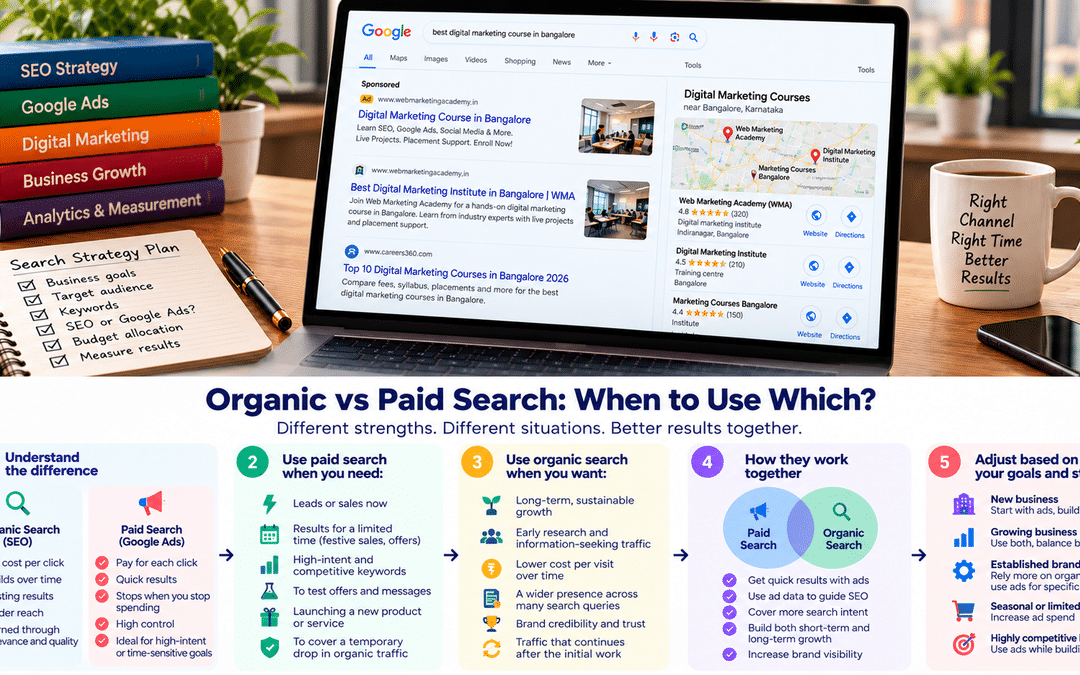
“Should we do SEO or Google Ads?” It’s one of the first questions business owners ask when they decide to take search seriously. Agencies often answer based on what they sell: SEO agencies say ads are a waste of money once you stop paying, and ad specialists say SEO takes too long to matter.
Both are partly right, which is why the question itself is a little misleading. Organic search and paid search do different jobs. They differ in cost, speed, durability, and control, and most businesses benefit from using them together, with the balance shifting as the business grows.
The more useful question is: for this business, at this stage, with this budget and these goals, what should each channel be doing?
This guide explains how organic and paid search differ, when each makes sense, how they strengthen each other, how to think about splitting a budget over time, and how AI search is changing the balance. It’s written for business owners, marketing managers, and marketers advising clients.
Organic vs paid search: how they differ
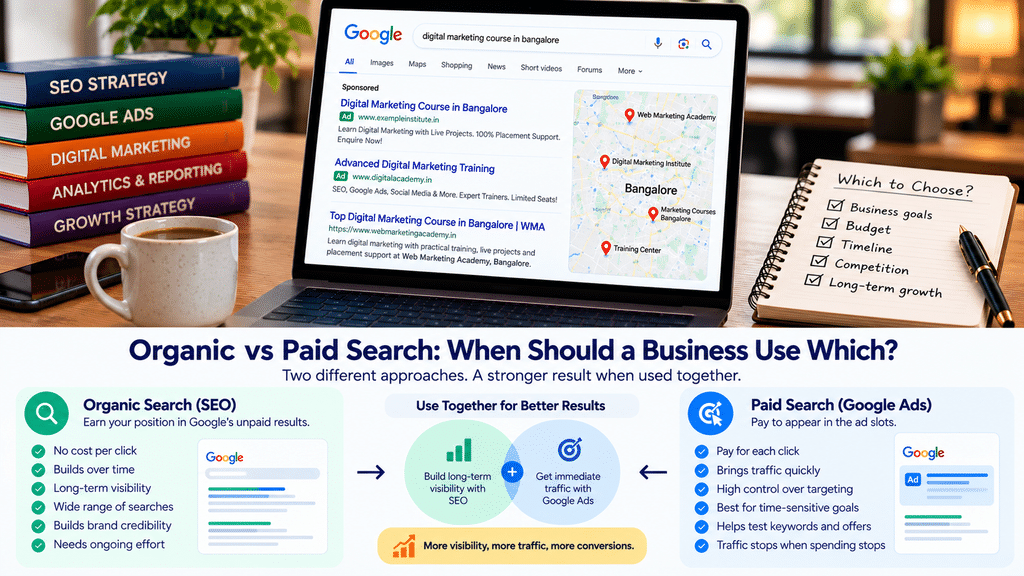
Organic search means appearing in Google’s unpaid results because Google judges your pages relevant and useful. You earn the position through SEO: content, technical health, local presence, and reputation.
Paid search means paying to appear in the ad slots, usually through Google Ads, on a cost-per-click basis. You buy the position through bids, budget, and ad quality.
Google keeps the two separate. It says organic results aren’t influenced by whether a business buys ads so ad spend won’t improve your organic rankings.
| Organic search (SEO) | Paid search (Google Ads) | |
| Cost model | No cost per click; you invest time, content, and expertise | Pay for each click |
| Speed | Usually months to build | Can bring traffic within hours of approval |
| Durability | Rankings can last long after the work is done, though they need maintenance | Traffic stops when spending stops |
| Control | Limited: Google decides rankings and how results appear | High: you choose keywords, locations, times, budgets,s and ad copy |
| Scalability | Grows gradually with content and authority | Scales quickly with budget, within available demand |
| Testing | Slow to test changes | Fast to test offers, messages and landing pages |
| Cost over time | Cost per visit tends to fall as rankings grow | Cost per click can rise as competition increases |
| Reach | Wide range of searches, including early research | Usually focused on high-intent searches you choose to pay for |
| Risk | Algorithm updates can shift rankings | Rising costs, policy changes, budget limits |
Neither column is better. They suit different jobs, and their strengths fill each other’s gaps.
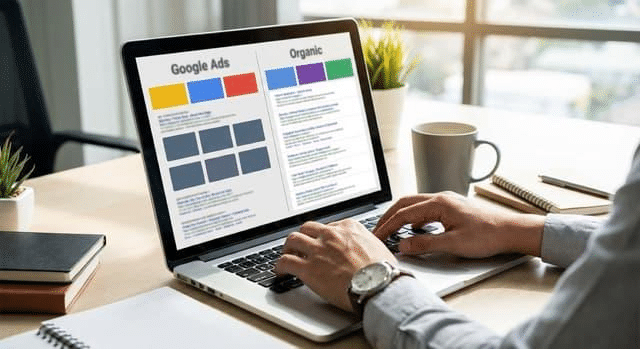
When paid search makes sense
Paid search works best when you need results quickly, timing matters, or you want precise control.
You need leads or sales now. A new business, a new branch, or a new service can’t wait six months for rankings. Ads can start bringing inquiries almost immediately, as long as the setup and landing pages are sound.
Demand is seasonal or time-limited. A Diwali sale, an admission season, a monsoon-related service, or a limited-time offer has a window. Ads let you appear exactly when demand peaks and stop when it ends.
The searches are highly commercial and competitive. For searches like “emergency plumber Whitefield” or “buy running shoes online”, the top of the page is often dominated by ads and map results. Ads may be the most reliable way to appear prominently.
You want to test before investing. Ads tell you within weeks which keywords, offers,s and messages convert. That’s valuable before committing months of SEO effort to a keyword.
You’re launching something new. People don’t search for a product they’ve never heard of, but ads can capture searches for the problem it solves while awareness builds.
Organic results are temporarily weak. After a site migration or a ranking drop, ads can protect inquiries while the underlying problem is fixed.
The conditions that make ads work
Ads pay off only when the basics are in place: conversion tracking for calls, WhatsApp, and forms; landing pages that match the ad; someone ready to respond; and a cost per customer that fits your margins. Our guide to Google Ads on a small budget covers this setup.
When organic search makes sense
Organic search is strongest when you’re building for the long term, when buyers research before deciding, or when paying for every click would be too expensive.
You plan to be around for years. Rankings take time to build, but they keep working without a cost per click. A guide that ranks well can bring visitors for a long time with occasional updates.
Customers research before buying. For courses, healthcare, home renovation, B2B software, or financial services, people read, compare,e and ask questions before they enquire. Content that answers those questions builds trust before a competitor’s ad ever appears.
Clicks are expensive in your category. In some industries, each ad click can cost a lot. Organic rankings for the same searches can be far more cost-effective over time.
You want to cover many searches. Ads work best on a focused set of high-intent keywords. Organic content can reach hundreds of related questions and long-tail searches that would be impractical to bid on individually.
You’re a local business. Your Google Business Profile, reviews, and local pages can bring a steady stream of nearby customers, often more reliably than ads for everyday searches.
Trust matters. Many people skip ads and click organic results, especially for research. Appearing organically and in Google’s AI features signals that your content has earned its place.
The conditions that make SEO work
Organic search pays off when you can invest consistently: a technically sound site, genuinely useful content, a solid local presence where relevant, and patience measured in months. It also needs someone who understands what to prioritize; our SEO audit guide is a good place to start.
How the two work better together
The strongest search strategies don’t treat organic and paid as rivals. Each makes the other more effective.
| What paid search gives organic | What organic search gives paid |
| Conversion data by keyword. Ads show which searches actually produce inquiries and sales, which tells you which keywords deserve SEO investment | Trust and familiarity. People who’ve read your helpful content are more likely to click your ad later |
| Fast message testing. Try different headlines in ads, then use the winners in your page titles and meta descriptions | Better landing pages. Pages built for SEO with useful, specific information often convert ad traffic better too |
| Coverage while rankings build. Ads fill the gap for important searches where you don’t rank yet | Lower dependence on ad spend. As organic traffic grows, you can focus ads on what organic can’t reach |
| Remarketing audiences. Visitors from organic search can be shown ads later, if they’ve consented to tracking | Quality signals. Relevant, useful landing pages support stronger ad performance |
Should you bid on your own brand name?
If you already rank first for your brand, paying for brand searches might seem wasteful. But competitors can bid on your brand name, and an ad can give you extra space and control over the message. Brand clicks are often inexpensive.
The honest answer is to test it. Pause brand ads for a few weeks in a controlled way and watch total brand clicks, organic plus paid, and inquiries. If they barely change, the ads may be unnecessary. If competitors start taking those clicks, the ads are earning their keep.
Should you stop ads when you rank organically?
Sometimes. If you rank first organically for a search and also run ads on it, some ad clicks would have come through organic anyway. Test carefully, keyword by keyword, before switching ads off, because the page layout and competitor ads also affect how many people click your organic result.
One product feed, two uses
For e-commerce, a single Google Merchant Center feed powers both free product listings and Shopping ads. It’s one of the clearest examples of organic and paid sharing the same groundwork.
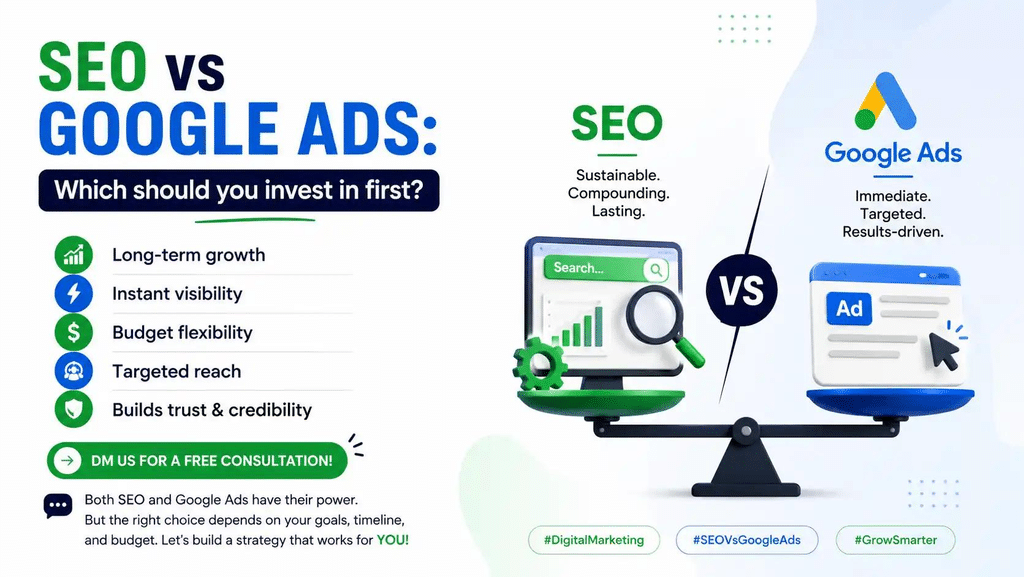
A decision guide by business situation
There’s no universal split, but common situations point in fairly clear directions.
| Situation | Lean towards | Why |
| Brand-new business needing customers quickly | Paid first, while starting SEO foundations | Ads bring early inquiries and data; SEO takes months to build |
| Local service business, such as a clinic, salon or repair service | Organic local presence first, with targeted ads for key services | A strong Business Profile and reviews often drive steady local inquiries; ads fill gaps and cover busy competitive searches |
| E-commerce brand | Both, from early on | Free listings and SEO build long-term traffic; Shopping and Search ads drive sales and test products |
| B2B or high-consideration service with long sales cycles | Organic content as the core, with ads for high-intent searches | Buyers research extensively; content builds trust; ads capture people ready to talk |
| Seasonal business, such as admissions or festive products | Organic content ahead of the season, ads during peaks | Content needs time to rank; ads let you scale exactly when demand rises |
| Very limited budget | Organic and local foundations first, small focused ads only if tracking is solid | Small ad budgets learn slowly; SEO and Business Profile work cost time rather than clicks |
| Established business with strong rankings | Organic as the base, ads for growth and protection | Use ads for new services, competitive terms, and brand protection |
| Highly regulated or ad-restricted category | Organic, with careful use of ads within the rules | Some categories face advertising restrictions; organic content may be the main route |
Questions that settle most decisions
- How quickly do you need results?
- What is a new customer worth to you, and what can you afford to pay to acquire one?
- How competitive and expensive are clicks for your key searches?
- Do your customers research for weeks, or decide in minutes?
- Do you have the time or people to create genuinely useful content?
- Is your tracking good enough to judge ads properly?
If you need results fast and know your customer value, ads deserve a bigger share early. If you have time, expertise, and a long sales cycle, organic deserves more.
How to split the budget over time
The right balance changes as a business grows. Rather than picking a fixed percentage, think in phases.
| Phase | Paid search | Organic search |
| Starting (roughly the first few months) | Carries most of the lead generation. Focused on a small set of high-intent searches, with tracking set up properly | Foundations: technical health, core service or product pages, Google Business Profile, first few genuinely useful pieces of content |
| Building (often months 4 to 12) | Optimized using real conversion data; budget shifted to the keywords and ads that bring customers | Growing steadily: content targeting searches that ads proved valuable, reviews, links and mentions |
| Established (after a year or more) | More selective: new services, competitive terms, seasonal peaks, brand protection | Often the larger, steadier source of traffic and inquiries |
These phases are a general pattern, not a guarantee. Some businesses, especially in highly competitive categories, rely on ads longer. Others, such as local businesses with strong reviews, build organic visibility quickly.
Count the full cost of each channel.
SEO isn’t free just because there’s no cost per click. It costs time, content creation, technical work, and often agency or freelancer fees. To compare fairly:
- Paid search cost per customer = ad spend plus management cost ÷ customers from ads
- Organic search cost per customer = SEO time, content and agency costs ÷ customers from organic search, measured over a longer period.
Organic usually looks expensive in the first months, when costs come before results, and cheaper later as rankings compound. Paid search usually costs about the same per customer over time, or rises as competition grows.
Review the balance every quarter.
Every three months, look at leads and customers by channel, cost per customer for each, and which important searches you now rank for organically. Shift budget towards what’s working, and reduce ad spend on searches where organic now performs strongly, after testing the effect.
How AI search changes the balance
Google’s AI Overviews and AI Mode, and AI assistants like ChatGPT, are changing what both channels can deliver.
For organic search
- Simple informational searches may send fewer clicks. When an AI Overview answers a basic question directly, fewer people may need to visit a website. Generic “what is” content is most exposed.
- Being cited becomes a form of visibility. Google’s AI features draw on pages its systems already rank and link to sources. Search Console’s generative AI report now shows how often your pages appear in them.
- Original, experience-based content matters more. Google’s AI search guidance emphasizes non-commodity content: first-hand experience and expert insight that an AI summary can’t replace.
- Commercial and local searches still lead to visits. People booking a service, comparing products, or finding a nearby business still need to click, call, or visit.
For paid search
- New ad placements. Ads can now appear within AI Overviews and AI Mode. Campaigns using broad match keywords or AI Max for Search are eligible, according to Google’s Ads Liaison.
- Less visibility into performance. Ads shown in these placements are currently reported together with other top-of-page ads, so it’s hard to judge them separately.
- More automation. AI Max and broader matching give Google more control over which searches trigger your ads. Conversion tracking and negative keywords matter even more.
What it means for the balance
For many businesses, AI search strengthens the case for combining both channels. Organic content should shift toward genuinely useful, specific material that earns citations and visits, not generic definitions. Paid search becomes more important for high-intent searches where an AI answer pushes organic results further down the page.
Our guides to GEO vs AEO vs SEO and AI Max for Search explain both sides in more detail.
Worked example: a Bangalore coaching institute
This is a hypothetical example. The figures are illustrative.
The situation. A commerce coaching institute with a well-known Jayanagar center opens a new branch in HSR Layout. The new branch has no reviews, no rankings, and an empty classroom. The owner asks whether to spend on Google Ads or SEO.
Months 1 to 3: paid search leads, organic foundations start.
- Google Ads targets high-intent searches such as commerce coaching and exam preparation classes in HSR Layout and nearby areas during counseling hours.
- Conversion tracking covers calls, WhatsApp clicks, and form submissions.
- A dedicated branch page is built, with batch timings, faculty, fee range, and directions.
- The branch gets its own Google Business Profile, and staff start asking enrolled students for reviews.
Months 4 to 12: data from ads shapes SEO.
- The search terms report shows that weekend batches for working professionals convert unusually well. The institute creates a detailed page and two guides on that topic.
- Reviews build steadily, and the branch starts appearing in local map results.
- Ad spend shifts away from searches where the branch now appears prominently on the map, after testing showed inquiries held steady, and towards weekend batch searches and exam-season peaks.
Year two: organic becomes the base.
| Source of inquiries | Months 1 to 3 | Year two |
| Google Ads | Most enquiries | A smaller share, concentrated in exam and admission seasons |
| Google Business Profile and local search | Very few | A large, steady share |
| Organic search to guides and pages | Almost none | A growing share, especially for weekend batches |
| Referrals and direct | Some | Some |
Ads didn’t become useless; they became more selective. Organic search didn’t replace them; it reduced how much the branch needed to spend to fill each batch. The two channels do different jobs at different stages, which is why you combine them.
Common mistakes
Treating it as either-or. Most businesses benefit from both, in different proportions at different stages.
Expecting SEO to deliver in weeks. Organic results usually take months. Starting SEO only when you need leads urgently leads to disappointment and abandoned efforts.
Expecting ads to fix a weak website. Ads send people to your pages. If those pages are unclear, slow, or untrustworthy, ads just pay to send more people away.
Believing ads improve organic rankings. Google says they don’t. Choose ads for what they actually do.
Running ads without conversion tracking. Without it, you can’t tell which keywords bring customers, and you lose the most valuable data ads can give your SEO.
Writing generic SEO content. Pages that only restate common knowledge struggle to rank and are the most exposed to AI Overviews. Content needs a real point of view or first-hand information.
Never revisit the balance. A split that made sense at launch may be wasteful two years later. Review channel performance every quarter.
Comparing channels on the wrong numbers. Compare cost per customer, including all costs, not cost per click against “free” organic traffic.
Frequently asked questions
What is the difference between organic and paid search?
Organic search results are unpaid listings Google ranks based on relevance and quality. Paid search results are ads, usually bought through Google Ads, where you pay each time someone clicks.
Is SEO or Google Ads better for a small business?
It depends on how quickly you need results and your budget. Ads can bring inquiries quickly but cost money per click. SEO and a strong Google Business Profile take longer but can bring steady inquiries without paying per click. Many small businesses start with focused ads while building their organic and local presence.
Does running Google Ads help my SEO?
Not directly. Google says ad spending doesn’t influence organic rankings. Ads can help indirectly by showing which keywords convert, so you know where to focus your SEO efforts.
How long does SEO take compared with Google Ads?
Ads can start bringing traffic within hours of approval. SEO usually takes months to show significant results, depending on competition and your site’s condition.
Should I stop running ads once I rank organically?
Not automatically. Test pausing ads on searches where you rank strongly and watch total clicks and inquiries. Sometimes ads add little; sometimes competitors take the clicks you give up.
How should I split my budget between SEO and ads?
There’s no fixed rule. New businesses often rely more on ads early while building SEO foundations, then shift towards organic as rankings grow. Review cost per customer for each channel every quarter and adjust.
Do AI Overviews make SEO less valuable?
They change it. Simple informational searches may drive fewer clicks, but commercial and local searches still drive visits, and pages cited in AI answers gain visibility. Original, specific content is more valuable than ever.
Where can I learn both SEO and Google Ads?
Practicing both on real projects is the best way to understand how they work together. At Web Marketing Academy, we teach SEO and Google Ads through hands-on work on live projects, plus analytics.
